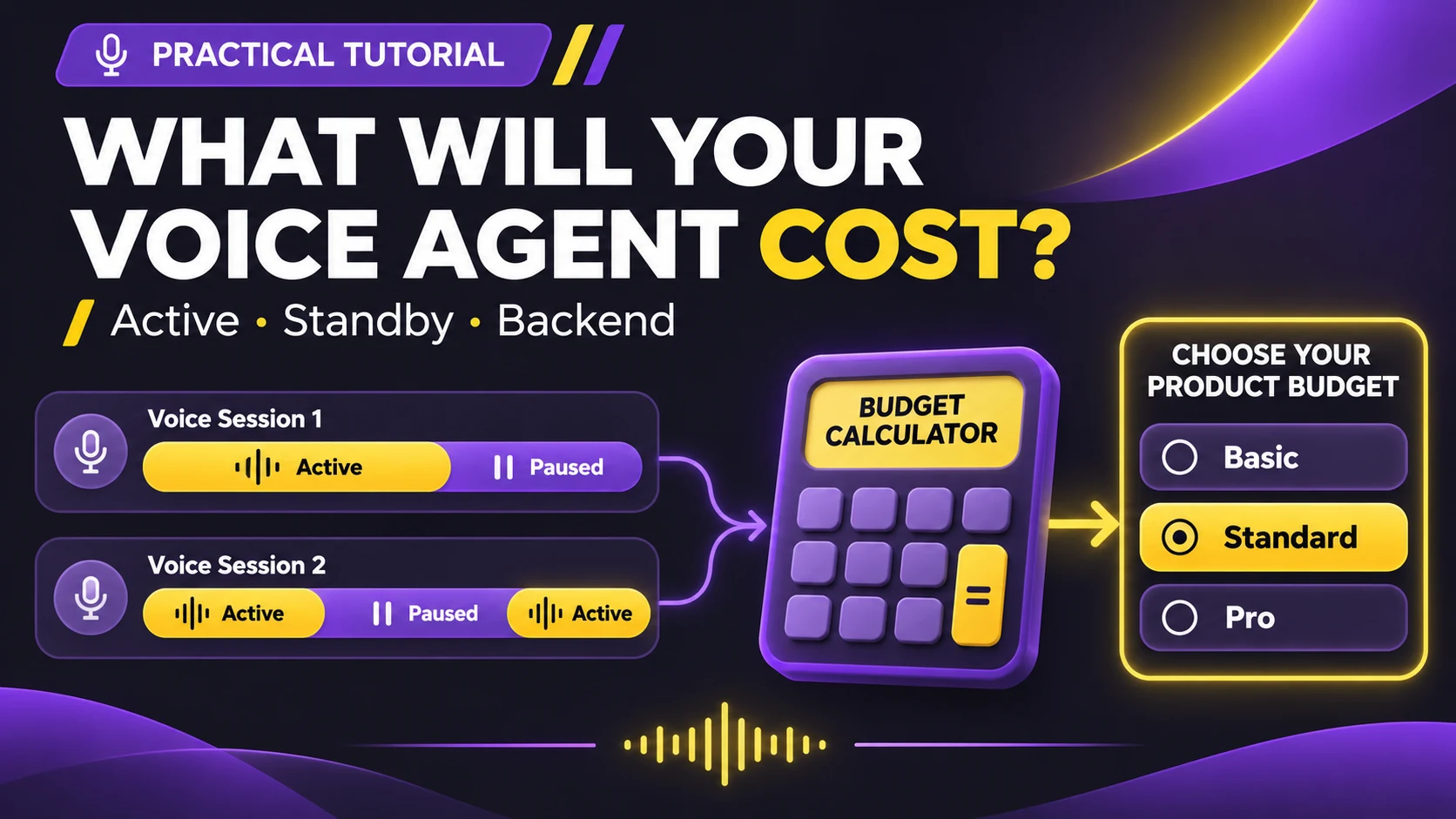
You're building a voice agent that books appointments. Before tuning its accent, you need to know whether 100 conversations a day fit your budget. GPT-Live-1.1 is billed by session duration: $0.05 per active minute and $0.02 per standby minute. The cheaper standby rate applies to WebRTC sessions while inference is paused. A quiet caller does not automatically prove that your session entered standby. Backend models and tools are billed separately.
The product decision
Suppose each call lasts five minutes: two minutes of active conversation and three minutes while the user checks a calendar. You expect 100 sessions per day for 22 days. Is it worth implementing a real WebRTC pause? The calculator below separates voice time from an explicit backend assumption and compares that plan with leaving all five minutes active.
The rates are from OpenAI's published pricing as checked on November 20, 2026. They are inputs to an estimate, not a promise for your account. Recheck the pricing page before committing a budget.
Copyable Python calculator
Save this as budget.py and run python3 budget.py. It uses Decimal to avoid floating-point surprises in dollar calculations. It makes no API request.
from decimal import Decimal

ACTIVE = Decimal("0.05") / 60
STANDBY = Decimal("0.02") / 60

def estimate(active_s, standby_s, sessions_day, days, backend):
    values = (active_s, standby_s, sessions_day, days)
    if any(type(v) is not int or v < 0 for v in values):
        raise ValueError("Use nonnegative whole numbers")
    backend = Decimal(str(backend))
    if backend < 0:
        raise ValueError("Backend cost cannot be negative")
    n = sessions_day * days
    voice = active_s * ACTIVE + standby_s * STANDBY
    always_active = (active_s + standby_s) * ACTIVE
    return {
        "sessions": n,
        "per_session": voice + backend,
        "monthly": n * (voice + backend),
        "always_active_monthly": n * (always_active + backend),
        "standby_savings": n * (always_active - voice),
    }

result = estimate(120, 180, 100, 22, "0.002")
for key, value in result.items():
    print(key, value)
assert result["monthly"] == Decimal("356.400")
assert result["standby_savings"] == Decimal("198.000")
Locally checked output
I ran the calculation with Python 3. It produced 2,200 sessions, $0.162 per session, $356.40 per month with standby, and $554.40 if all five minutes remain active. The estimated difference is $198 per month. The $0.002 backend cost per session is an editable assumption, not an official OpenAI rate.
| Scenario | Voice per session | Monthly total with backend |
|---|---|---|
| 2 active min + 3 standby min | $0.16 | $356.40 |
| 5 active min | $0.25 | $554.40 |
That comparison supports a concrete choice: if calls really contain three paused minutes and pausing does not hurt the user experience, measure the standby path in a prototype. If the agent keeps listening or responding during those three minutes, do not classify them as standby just to improve the spreadsheet.
Replace the assumptions with measurements
- Record total, active, and actually paused seconds for ten trial sessions. Keep personal information out of the cost log.
- Replace
active_s,standby_s,sessions_day, anddayswith your observed or planned values. - Calculate your real backend cost per session, including model and tool calls, and replace the
backendinput. - Compare the estimate with actual billing and leave room for retries, long calls, and peak traffic.
This simple model assumes identical session lengths. It does not model the duration distribution, taxes, infrastructure, concurrency limits, or discounts. I did not run a paid GPT-Live session to validate an invoice. Use this calculator to decide what architecture to test; actual session state and billing are the final check.