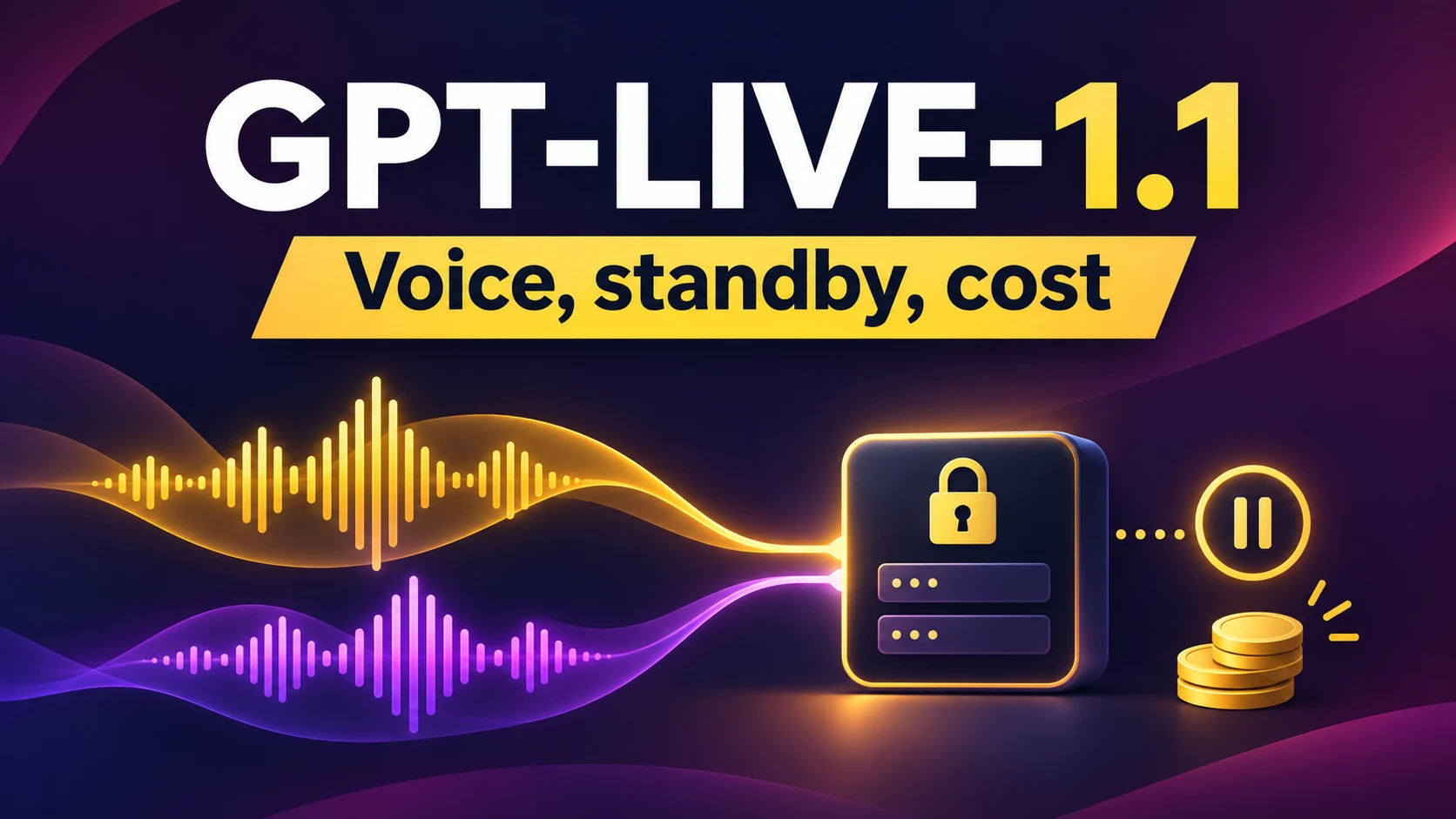
Imagine a bilingual customer-support voice agent that must catch order numbers, names, and amounts while keeping the conversation moving. OpenAI added GPT-Live-1.1 to the API on November 19, 2026. Its model documentation says transcription, pronunciation, and accent consistency improve over GPT-Live-1. There is also a standby setting for WebRTC calls that remain connected through quiet periods at a lower voice-session rate. This is a developer API release; previous use of the model inside ChatGPT was not the same as access for your own app.
What changes in a voice product
If you already use GPT-Live, set the session model to gpt-live-1.1 and keep the rest of your test stable. The architecture still has two jobs: GPT-Live listens and speaks, while your backend reasons, looks up records, or calls tools when the voice layer delegates. OpenAI advises telling the model in plain language when to delegate. A test instruction might say: “For a real order-status question, ask the backend before giving a delivery date. Repeat the order ID you heard and ask for confirmation before changing any record.” That is an editorial test prompt, not a claim that we validated it in a live call.
For WebRTC sessions, standby can pause inference after 5–60 seconds of inactivity without closing the call. Conversation resumes when someone speaks. This matters for a tutoring or support flow with frequent pauses; it does not make idle time free.
Estimate the voice cost before building
OpenAI lists $0.05 per active minute and $0.02 per standby minute for GPT-Live-1.1, billed per second. Backend model calls and tools are separate charges. An illustrative ten-minute call with six active minutes and four standby minutes costs $0.38 for the voice session alone (6 × $0.05 + 4 × $0.02). At the active rate for all ten minutes, that part would be $0.50. Your actual bill depends on the measured state of the session and extra services.
A founder should look at the ratio of talk time to silence, the latency after standby, and the value of the task the agent completes. An almost nonstop sales conversation may save little. A learning app with thinking pauses may benefit more. Do not use this sample arithmetic as a return-on-investment claim.
A controlled evaluation you can run this week
- Start from the official GPT-Live guide or an existing integration. OpenAI recommends WebRTC for interactive audio. Hold your backend, task, and audio examples constant while switching between GPT-Live-1 and 1.1, if both are enabled for your organization.
- Prepare five utterances containing proper names, digits, and code switching. Save the intended text and compare it with transcripts, rather than scoring the voices by memory.
- Ask one question that requires a test backend lookup, such as a fictional order status. Check that the assistant delegates and uses the returned value instead of guessing.
- In a WebRTC session, configure a standby timeout within the documented range. Measure silence, wake-up delay, active and standby seconds, plus backend cost. Keep test data fictional and set a small spending budget.
We have not run this API comparison with an account. A useful pass condition is fewer errors on the phrases your customers actually say without a harmful delay or cost increase. Keep the recordings and transcripts so you can rerun the same check after a model or prompt change.
Product limits
The model supports audio and text, but the model page lists image and video as unsupported. Concurrent-session limits vary by organization. The standby price applies when inference is paused in a WebRTC session; it is not a blanket discount on backend reasoning or tools. Better speech does not remove the need for confirmation before payments, account changes, or customer promises.
Primary sources: OpenAI API changelog (November 19, 2026), GPT-Live-1.1 model documentation, GPT-Live guide, and official pricing.