Your coding agent might be asked to adjust a simple screen or trace a bug across an API, database, and frontend. Those are different jobs. On November 17, 2026, OpenAI launched GPT‑6.2 Sol and GPT‑6.2 Astra in Codex, ChatGPT Work, and the API. For an indie builder, the useful question is whether Sol handles the repeatable work and when Astra earns its higher API price on a harder task.
What actually launched
OpenAI positions Sol for everyday coding, writing, and multistep work. Astra is the stronger option for difficult end-to-end projects, such as diagnosing a bug across services and testing the fix. Those are vendor descriptions, not a SoyJB benchmark. The API model IDs are gpt-6.2-sol and gpt-6.2-astra. Both take text and image input and return text. Neither model's listing promises audio or video output.
In Codex, select a model in the app or use /model in the CLI. Official guidance also lists codex -m gpt-6.2-sol and codex -m gpt-6.2-astra. Work availability depends on your plan and client; Enterprise and Edu administrators must enable access. The API supports Responses and Chat Completions, while tool calls require Responses. I have not run a billed API request or tested these models in Joseph's account.
Put API pricing in the right context
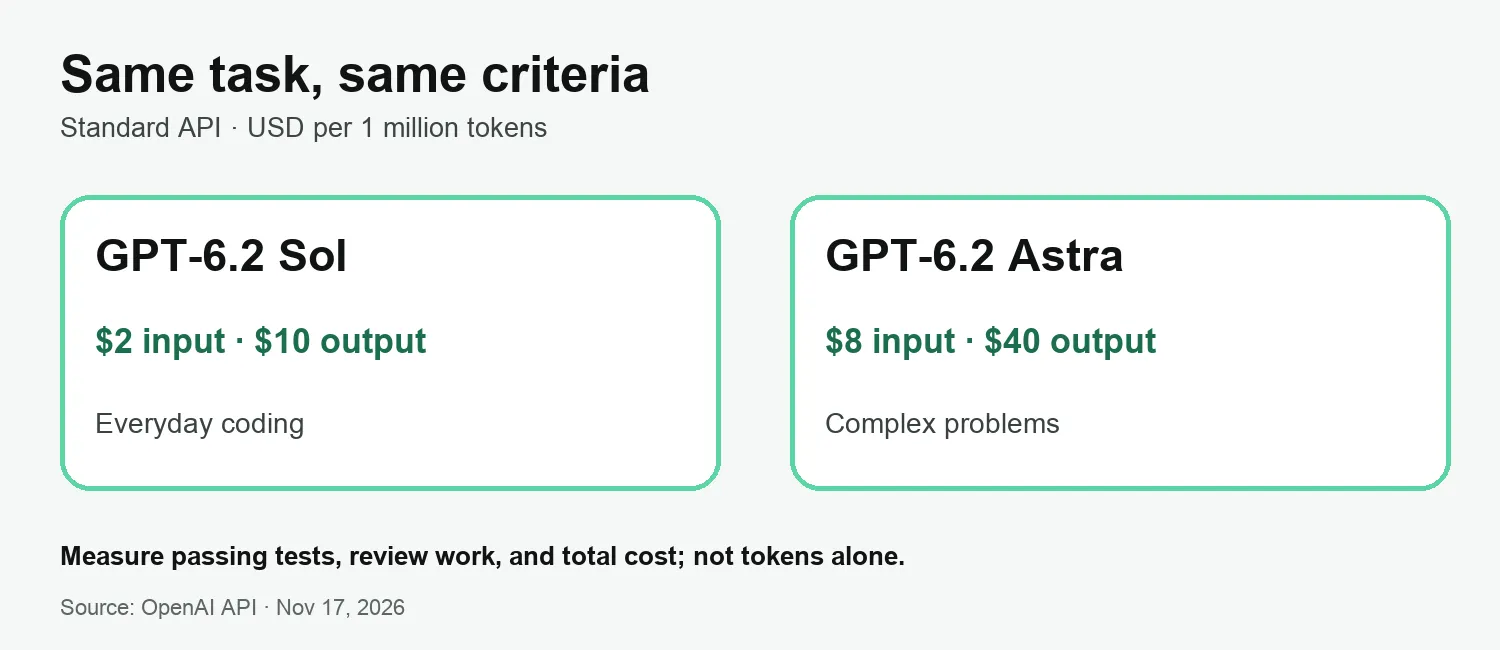
At Standard rates for shorter API requests, Sol is $2 per million input tokens and $10 per million output tokens. Astra is $8 input and $40 output. These are API token prices, not the credit cost of a Work or Codex subscription. Cached input, cache writes, service tiers, and long requests have separate rules. If a request exceeds 272,000 input tokens, the official model pages say input and cache rates double and output costs 1.5 times the short-context rate for the entire request. Large context can therefore change your evaluation budget.
For illustration, 10,000 input tokens plus 2,000 output tokens, with no cache or separately billed tools, work out to about $0.04 on Sol and $0.16 on Astra. That is arithmetic using listed rates, not an observed bill or an estimate for a full agent run. A real task may involve multiple calls, tool use, and retries. Cost per accepted result is more meaningful than a token price alone.
A fair test on your own product
- Pick one issue with an observable acceptance criterion. For example, “a second user must not see another user's saved note.” Create a test branch and give both models the same starting files, instructions, and permissions.
- Run Sol first. Ask it to identify the cause, implement the smallest fix, and run the relevant tests. Save the output, attempt count, elapsed time, and usage your tool reports.
- Reset the branch to its original state and run Astra. Do not show it Sol's proposed solution; both should start with the same information.
- Compare passing tests, regressions, review work required to accept the change, and observed cost. If both fail, record the blockers instead of declaring a winner.
Use the same prompt in both runs:
Goal: fix [observable bug] in this repository.
Acceptance criteria: [list of testable behaviors].
Before editing, find the cause and explain your hypothesis.
Make the smallest change, run the affected tests, and report:
files changed, commands run, results, remaining risks, and any
unavailable file or tool. Do not claim success if a test fails
or could not be run.
Make the decision this week
If Sol regularly meets the same acceptance tests with less cost, start there. If it gets stuck on a cross-service problem, try Astra and include your own review time in the comparison. Content teams can adapt this approach with the same sample briefs, grading factual accuracy, voice, and edits required. A result on a coding bug does not establish which model writes better marketing material.
Today's launch does not prove Astra wins every task or that Sol is enough for every product. OpenAI reports benchmark results under particular test conditions; your workflow, tools, and context can differ. Check your account limits, region, and access before promising customers a model-specific feature.