Claude Opus 4.8 fast mode is retiring: migrate your coding agent safely
Anthropic will retire Opus 4.8 fast mode on November 30, 2026. Find affected agents and test a move to Opus 5.5 without breaking tool calls or response handling.

Başlıklar
Picture a pull-request reviewer using claude-opus-4-8 with speed: "fast". Its requests work today. If nobody updates that setting, the same request will return an error after November 30, 2026; Anthropic says it will not silently fall back to standard speed. The notice appears in Claude Code version 2.1.316, released October 31. This is a fast-mode retirement for Opus 4.8, not an announcement that the entire model is retiring.
The decision for your workflow
If you do not use Opus 4.8 fast mode, that deadline alone does not require a migration. If you do, you can remove the fast-speed request and check whether standard latency is acceptable, or move to claude-opus-5-5 with speed: "fast". Anthropic recommends Opus 5.5 to retain the speedup. Its fast-mode documentation says the gain is mainly in output tokens per second, not necessarily time to first token. The mode has premium pricing and separate rate limits. For the Claude API, Anthropic lists Opus 5.5 fast mode at $8 per million input tokens and $40 per million output tokens. API pricing is not a subscription usage allowance for Claude Code.
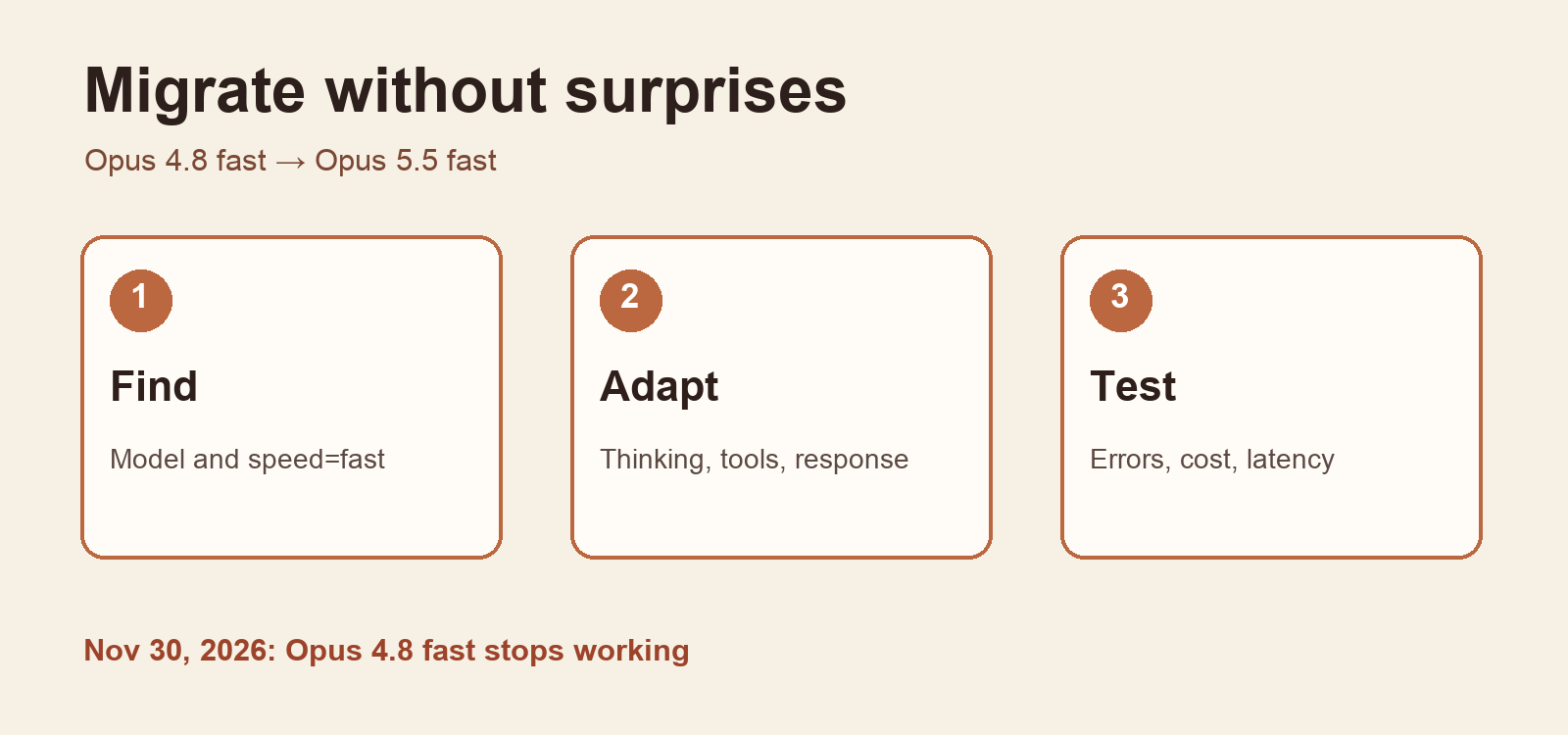
Find affected projects first
Run this search from the root of each repository that contains an agent. I tested it with a sample file: it finds the old model ID and references to speed. The latter is intentionally broad so you can inspect the relevant lines:
rg -n --hidden -g '!node_modules/**' -g '!.git/**' 'claude-opus-4-8|speed' .Check configuration outside Git as well: environment variables, deployment dashboards and managed-agent definitions. No match in a repository does not prove production is unaffected. Record which workflow uses fast mode, the latency it needs and a representative input you can replay without exposing private data.
Changing the model ID is not enough
Anthropic’s Opus 5.5 migration guide lists compatibility changes. Opus 5.5 always uses adaptive thinking: it rejects thinking: {"type":"disabled"} and manual thinking budgets. Use effort to control depth. Forced tool_choice values any and tool, certain sampling parameters and assistant prefill are also rejected. If your integration uses computer tools, check the tool version supported on your platform.
Response handling matters too. Code that always reads response.content[0].text can break because the first block may be a thinking block. Select text blocks by their type and preserve thinking blocks unchanged when sending tool results back, as Anthropic instructs. Also, max_tokens covers both thinking and visible text; a task that previously ran without thinking may need a different output limit. Do not carry over effort and latency assumptions without measurement.
A bounded production-readiness test
Pick three representative cases: a short answer, a long coding task and a tool call. In a test environment, run the current and candidate configurations against the same acceptance checks. Record validation errors, useful output, response block types, token use, cost and end-to-end latency. The API response’s usage.speed reports whether fast speed was actually used. Fast-mode capacity can produce a 429, which is different from a configuration error when an old model no longer supports fast mode. Source: Anthropic documentation.
This guide is based on primary documentation and a tested local search; I did not make paid Claude API requests. If your agent uses Opus 4.8 fast mode, schedule the test now. The announced deadline is November 30, and the right migration depends on your workflow’s behavior rather than the new model name alone.