Your Lovable app does not inherit SOC 2: four checks before inviting users
Lovable's certification does not automatically cover the app you build. Map data, test access with two accounts and check your claims before inviting customers.
Başlıklar
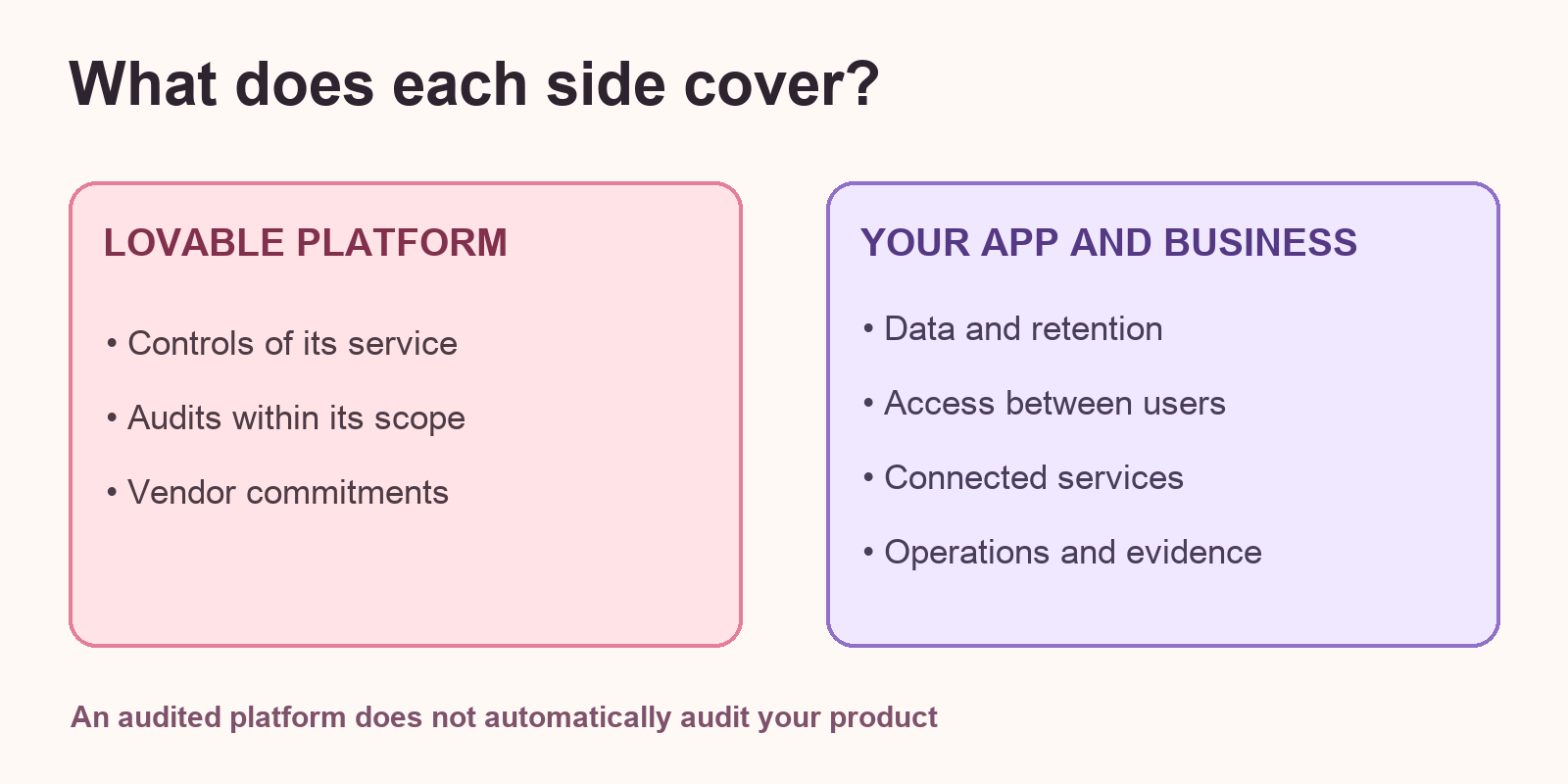
You build a small CRM in Lovable, connect a database and invite your first customers. One asks, “Is your app SOC 2 certified because Lovable is?” The responsible answer is no. In an official explanation published October 21, 2026, Lovable separates the platform's assessment from the controls in the app and business you operate. That boundary matters before real users upload contacts, files, payments or AI conversations.
Understand the boundary first
Lovable documents SOC 2 Type II, ISO 27001:2022, data protection support and AIUC-1 within their stated scopes. Those are evidence for assessing a vendor; they do not certify your product by inheritance. Your app determines what data it collects, who can read it, which connected services receive it, how long it is retained and how applicable access or deletion requests are handled. A project trust page is not an independent audit of your organization either. Check current evidence and scope in Lovable's Trust Center before making customer-facing claims.
Four checks before inviting customers
- Map the data path. List what enters through forms, accounts, uploads and chat; which tables hold it; and whether email, analytics, payments or AI models receive it. Choosing an EU database region does not establish that every connected service processes data there.
- Test access with two accounts. Create users A and B with separate records. From B, attempt to open A's record or uploaded file through both the UI and a direct URL. Repeat with a lower-privilege team role if your app has one. Hiding a button is not enough; the backend should reject unauthorized access.
- Rehearse a data request. Find a test user's information in your database and each connected service. Record who can correct or delete it, how a requester is identified and what must be retained for a valid reason. Do not promise complete deletion if a connected system still holds a copy.
- Check every public claim. Your privacy notice, trust page and sales copy should describe the app that actually runs. Do not call your business “SOC 2 certified” unless your own defined system has undergone an independent examination.
A prompt to start the audit
Lovable says its chat can inspect project context without modifying code; you can then move to Build to make changes. Use this prompt as a starting point and check every answer against the app:
Inspect this project without changing code. Return a table with: personal or sensitive data, where it is collected, where it is stored, which role can read it, external services that receive it, and how it is deleted. For each finding, cite the file, table, or setting you inspected. Mark anything you cannot verify as “unverified.” Propose three two-account tests for cross-customer access. Do not claim the app is certified.The AI output is a work map, not a certification. Ask for evidence: a table's access policy, storage permissions, the configuration of a connected service and the observed response with test accounts. After fixing a finding in Build, run the test again. A plausible explanation is not a passing test.
When the quick review is insufficient
Children's data, health information, sensitive financial information and formal enterprise requirements call for a deeper assessment. Work with qualified specialists on the requirements and independent review that apply to your case. For any founder, the practical rule is straightforward: before claiming “secure” or “compliant,” show what your own app actually controls. This guide draws on Lovable's public documentation; I have not audited your project or provided legal advice.