If your coding agent has been stuck on a migration for two days, there is a new model worth testing on that exact problem. On November 9, 2026, Anthropic announced Claude Fable 5.2 and Mythos 5.2. They share an underlying model, while Fable includes additional safeguards for cybersecurity and biology. Mythos is limited to verified organizations working in those areas. For an AI app builder, the near-term decision is to try Fable on one genuinely hard technical task and measure the outcome, rather than changing every workflow by default.
Availability and pricing
Anthropic says Fable 5.2 is available now in Claude, Claude Code, and the API, as well as on AWS, Google Cloud, and Microsoft Azure. Its Claude Platform model ID is claude-fable-5-2. Vercel announced same-day support through AI Gateway. Anthropic lists $8 per million input tokens and $40 per million output tokens. Optional fast mode costs $16 and $80 respectively; Anthropic claims up to 2.5 times faster token generation, which is not a guaranteed speedup for every job. Check your own plan and current price before running a large batch.
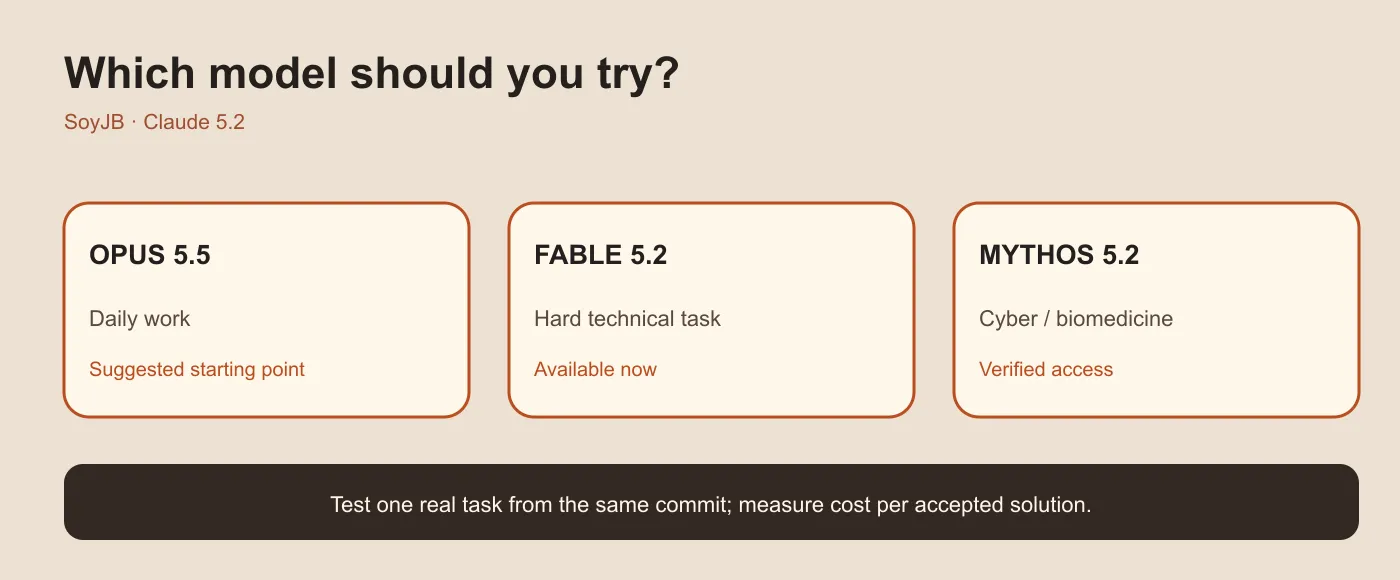
Mythos 5.2 is not an open model switch for ordinary accounts. Access goes through Anthropic's verification programs for beneficial cybersecurity or biomedical work. Most builders should evaluate Fable. Anthropic itself recommends Opus 5.5 as the daily starting point for most coding and knowledge tasks, moving up to Fable for unusually open-ended technical work. That is vendor guidance, not a SoyJB benchmark.
A fair test in your own repository
Choose a task you have already attempted with an observable success condition: a dependency migration with broken tests, a reproducible intermittent bug, or a UI component with accessibility requirements. Give Opus 5.5 and Fable 5.2 the same commit and problem statement. Keep secrets and personal data out of the test case. Ask each to make a scoped change and run relevant checks. Review the diff before accepting any edit.
In this repository, solve [specific bug or migration].
Before editing, state the likely cause and success criterion.
Make the smallest change that addresses the issue. Run relevant tests
and report commands, results, and modified files. If you cannot verify
something, say so. Do not alter deployment settings or unrelated
dependencies. End with what you checked and what remains open.
Log completion (yes/no), passing tests, defects found during review, time to an accepted solution, and actual tokens and cost. Repeat if your budget allows, since one generated run may be unrepresentative. Public benchmarks are a clue, but they do not reproduce your repo. Anthropic reports coding and speed gains over Fable 5.1 under its own evaluation conditions; treat those results as vendor-reported evidence.
GitHub Copilot users: check data retention first
GitHub confirmed on November 9 that Fable 5.2 is rolling out to Copilot Pro+, Max, Business, and Enterprise across VS Code, Copilot CLI, the coding agent, and other clients. Business and Enterprise admins must enable a model policy that is off by default. The crucial difference is data handling: GitHub says Fable 5.2 normally requires Anthropic to retain prompts and outputs for safety classifiers, though it says the data is not used for model training. Some eligible enterprises may receive a temporary zero-retention exemption, which needs account-team confirmation and explicit policy enablement. If a repository contains customer data or regulated code, check your organization’s policy before selecting the model and use a demo repository for the first comparison.
When to use each model
Keep Opus 5.5 for routine work if it already meets your quality bar. Try Fable 5.2 when a task requires exploring several approaches, coordinating a difficult migration, or reasoning through an ambiguous system. Choose by cost per accepted task, not token price alone. Do not design a normal product around Mythos unless your organization qualifies for its restricted access. For security or biomedical work, check the verification path and safeguards first.
For content creators, this release does not automatically mean better articles. Its practical value is in potentially building harder products. A useful test is a real feature with tests and visual review; only share the result after confirming it works. I did not run my own head-to-head Fable versus Opus comparison for this article.
Sources
Anthropic's official November 9, 2026 announcement and Vercel's same-day AI Gateway update. Pricing, access, and performance claims above come from these sources; the suggested test is a method, not a measured result.