One creator uses Claude to summarize official announcements, prepares ten drafts, and publishes the strongest pieces under their real publication. Another sets up five supposedly independent news sites, gives them invented bylines, posts the same claim, and makes the sites cite each other. Both use AI for content, but the second workflow disguises who is speaking and manufactures corroboration. That distinction matters for publishers automating their work.
Anthropic announced its update on October 8, 2026, and the revised Usage Policy takes effect November 12, 2026. The new section brings together prohibitions on deceptive campaigns and artificial activity that Anthropic says previously appeared across different rules. It is not a blanket ban on drafting or editing with Claude. The central concern is false attribution, manipulation, and artificial amplification.
What the policy actually says
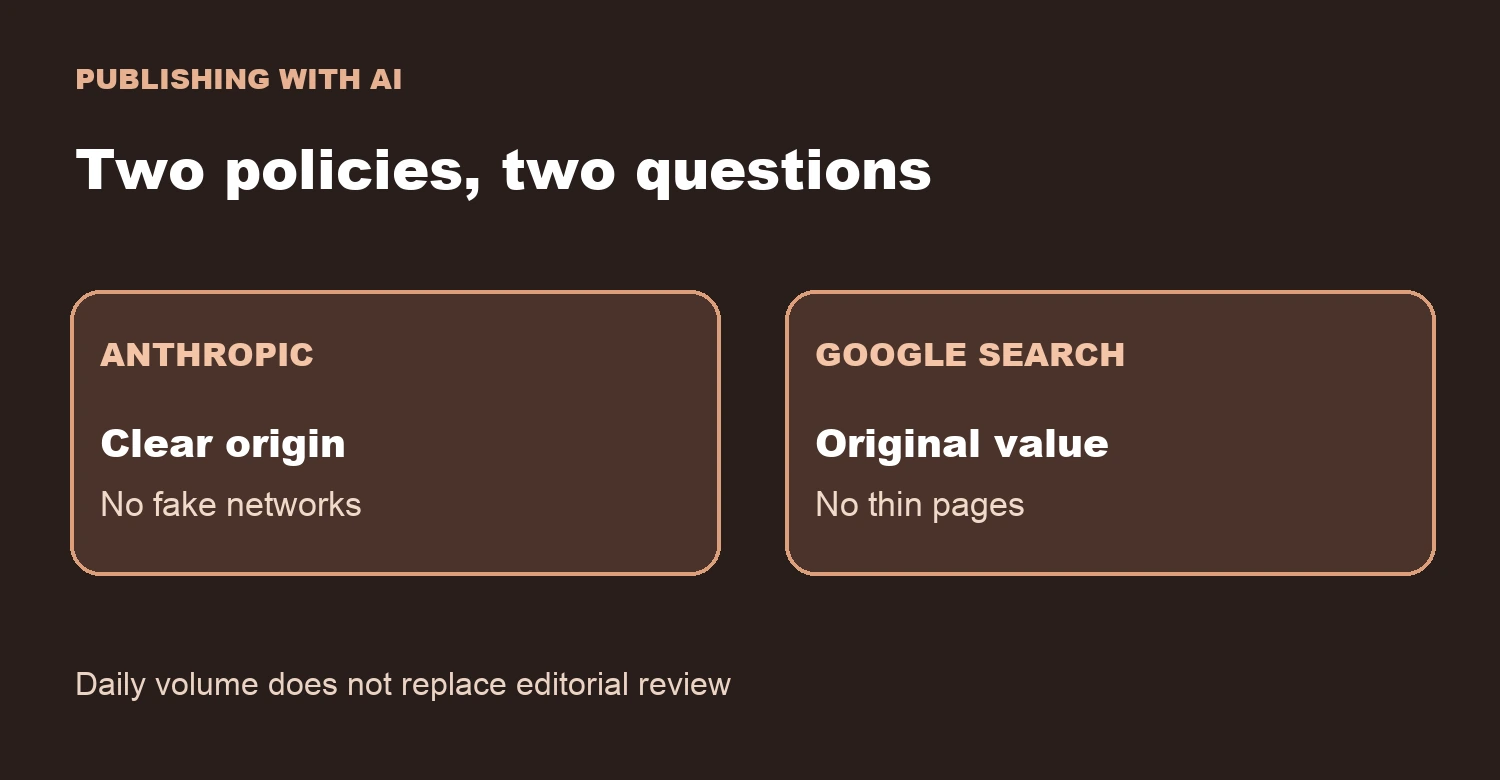
The text addresses fake personas, accounts, media outlets, and organizations used to mislead people about where a message comes from or how widely a view is held. It also covers distributing content through apparently independent sites or accounts to conceal a common origin, and seeding sources that seem to corroborate one another in order to influence search engines or AI answers. Building tools for those deceptive campaigns is also listed.
This section applies to political and commercial activity. Anthropic's summary calls it a consolidation of existing restrictions, not a declaration that every automated blog violates the policy. A story published by the real outlet, linked to original sources, with uncertainty made explicit is different from the invented-newsroom example. That last comparison is an editorial inference, not an individual approval from Anthropic.
Google Search has a separate rule
If search traffic matters to your business, you also need to consider Google's independent standard. Google describes scaled content abuse as generating many pages primarily to manipulate search rankings rather than help users. Its examples include AI-generated pages, scraped feeds, and automated transformations that add little value. The policy does not set a magic daily article count. Ten genuinely useful, distinct pieces are not automatically the behavior described; ten thin rewrites of one announcement move closer to Google's example. This is a reading of the published policy, not a promise of indexing or rankings.
The two policies govern different things. Anthropic governs use of Claude; Google determines how pages are treated in Search. A workflow can meet one standard and still produce low-value pages under the other. Publication volume cannot substitute for verified facts, original contribution, and a distinct reader intent for each URL.
A practical publishing workflow
- Log the original source. For news, save the official announcement or documentation, the event date, and who can actually use the feature. An X post can surface a lead but should not be the sole evidence of availability.
- Label facts, tests, and inference. “The company announced” is different from “we tested it.” Say when you lack access or the rollout is gradual.
- Use a real identity. Publish under your actual brand and byline. Do not create ostensibly independent sites to make your own claims look externally corroborated.
- Add a decision or demonstration. Offer reproducible steps, meaningful limitations, your own example, or a fair comparison using the same task. If a piece merely restates a press release, wait or improve an existing page.
- Review before publishing. Verify links, images, claims, language, and the public page. Keep the post ID and URL so corrections update the same page.
Should you stop automating your blog?
Neither document says that. Automating source collection, drafts, illustrations, adapted translations, and technical checks can save time. Editorial review still matters because automation can multiply a factual error, create duplicate pages, or describe an unperformed test as a result. If your business relies on a borderline interpretation, read the full policies and obtain advice appropriate to your case.
Today's check: pick the last article you made with AI and answer four questions. Is there a dated primary source? Are announced claims separate from hands-on results? Is authorship clear? Does this URL add something your other pages do not? If any answer is no, improve that page before increasing output. This article interprets public documents; we cannot know how Anthropic or Google will assess any specific case.