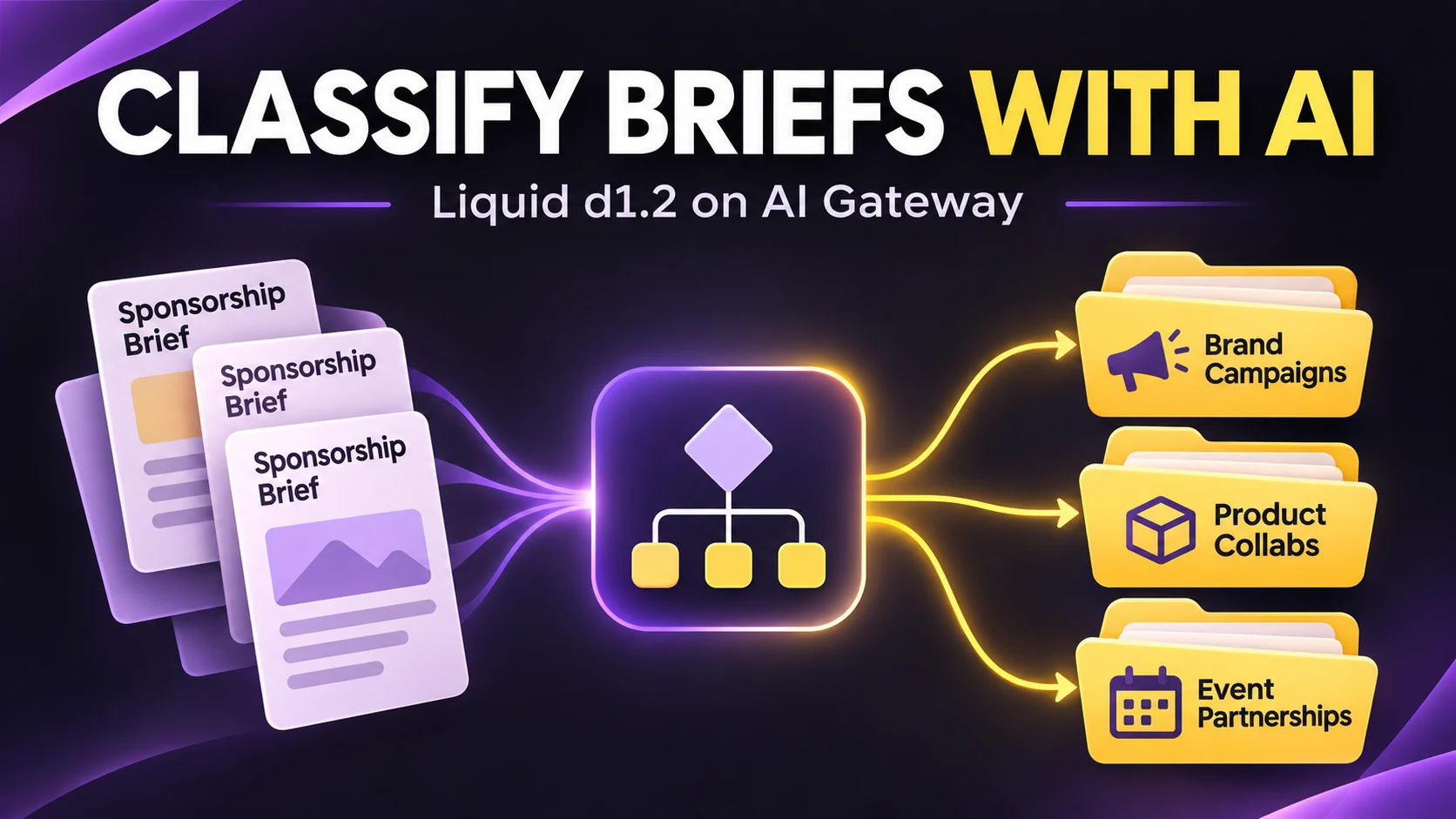
A creator receives a hundred collaboration pitches by email. Some include a deadline and clear deliverables; others just say “let's work together.” Before asking a generative model to write a long reply to each message, she can classify briefs and send incomplete ones to human review. As of November 19, 2026, Vercel AI Gateway offers Liquid AI's d1.2 and d1.2-ultra decision models for structured questions. The models predate this announcement; the change is access through Gateway with one key and usage logging.
Who can use the change
Decision models return probabilities for yes/no questions, category choices, or scores instead of drafting paragraphs. They can answer multiple questions about the same text, image, or audio input in one request. Vercel also documents audio input and bounding boxes for locating objects in images. For creators and founders, the immediate use is routing material before a person decides what to do: sponsorship briefs, support voicemails, forms, or images needing review.
Vercel describes liquid/d1.2 as the faster, lower-cost option and liquid/d1.2-ultra as the accuracy-focused model. Gateway's model pages listed $0.02 and $0.04 per million input tokens respectively when checked on November 20. They do not list a text-output rate because these models do not generate prose. Check current pricing and modality usage in your account before a batch. You need an AI Gateway key and billable access; I have not verified free credits or access in Joseph's account.
A concrete test: route a brief
Prepare ten fictional briefs with no personal information: five with explicit deadline, format, and objective; five that are ambiguous. In an AI SDK 7 project, use experimental_decide as documented by Vercel. This adapted snippet asks two questions about one fictional brief:
import { experimental_decide as decide } from 'ai';

const brief = 'We need a 30-second vertical video by Friday.';
const { answers } = await decide({
  model: 'liquid/d1.2',
  state: brief,
  questions: {
    hasDeadline: {
      type: 'boolean',
      instructions: 'Does the brief state a delivery deadline?',
    },
    asksForVideo: {
      type: 'boolean',
      instructions: 'Does the brief request a video deliverable?',
    },
  },
});
console.log(answers.hasDeadline, answers.asksForVideo);
This is an adaptation of the documented API, not an account-level test I ran. Today's test is to run it with your key and compare each probability with a human-labeled answer sheet. Do not choose an automation threshold until you have seen false positives and false negatives. “Friday” without a calendar date may still need clarification even if the model says the brief has a deadline.
What decision follows
If the batch classifies well and your bill matches the budget, use the output to sort an inbox, not to accept contracts, delete messages, or promise delivery automatically. Review low-confidence results and sample some high-confidence ones. If a task needs complex explanations or negotiation, a generative model plus human review may fit better.
For audio, Vercel provides a FLAC example that requires AI SDK 7.0.136 or later; its image example uses the Decisions API to find a signature. Those are documented capabilities, not tests performed here. Confirm consent, rights, and retention before uploading client audio or images. Inspect Gateway logs and budgets too: decision requests contribute to both.