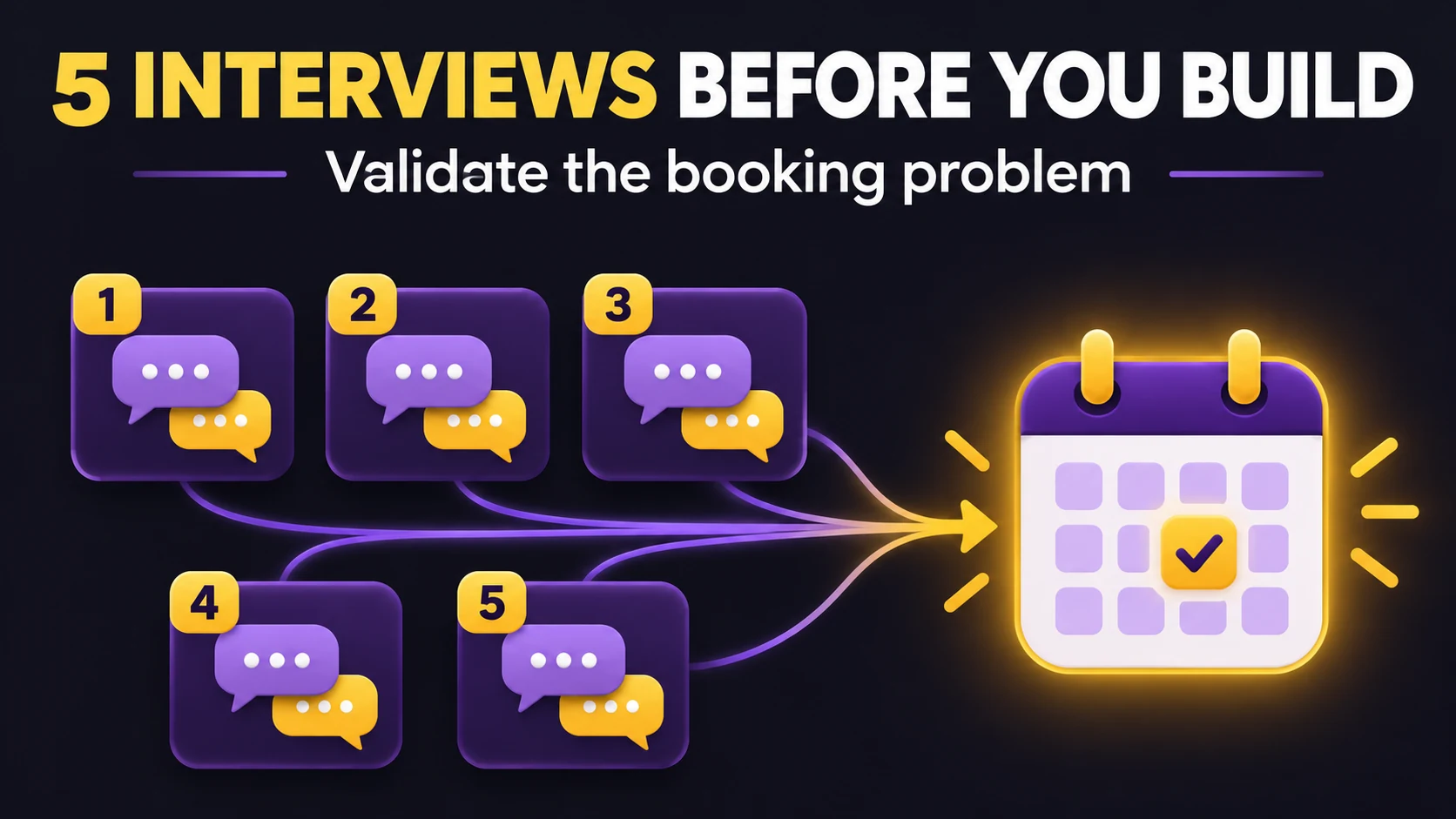
You can build a demo of an AI agent that answers messages and books appointments for beauty salons in an afternoon. But you still do not know whether the pressing problem is after-hours replies, no-shows, or calendar integration. Before coding all three workflows, talk to five actual businesses and record recent events. This guide prepares those conversations; it does not present imagined interviews as research.
The decision to make
By the end of the week you should be able to choose one workflow to prototype, change customer segment, or pause the idea. Y Combinator advises founders to ask about specific past incidents, existing workarounds, and real friction rather than opinions about a hypothetical product. Its guidance also stresses listening and taking notes instead of turning the interview into a pitch.
Recruit five comparable people
Pick a narrow segment: independent salons with two to eight staff members that take bookings through WhatsApp or Instagram. Recruit five people who manage scheduling, not five friends who never do it. Try this invitation: “I’m learning how salons handle bookings through messages. Could I have 15 minutes to understand the last scheduling problem you faced? I’m not selling anything.” Ask permission before recording; anonymized notes are enough for this exercise.
Do not show the demo first. Ask these questions and request details whenever an answer is vague:
- “Tell me about the last time a booking by message went wrong. What happened, when, and who had to fix it?”
- “How many similar incidents happened last week?” If they cannot recall, write “cannot recall” rather than turning an impression into a number.
- “What did you do to solve it? Could you show me the current process if you’re comfortable?”
- “What did it cost in time, money, or lost customers? How did you calculate that?”
- “What person or tool handles this today, and what is still difficult?”
Avoid “Would you use an AI assistant?” and “Would you pay $50?” These answers are weak signals: people may want to be polite or imagine a perfect product. Stronger evidence is an existing bill, a documented lost slot, a redacted view of their workflow, or time measured during a real task.
An evidence log you can copy
Fill in one row after each call. Leave unknown fields blank. Do not ask an AI summarizer to invent the missing details:
Profile | Last incident | Observed frequency | Current workaround
Cost or consequence | Approved quote | Unverified claim
Example: 3-person salon | Tuesday cancellation | cannot recall
manual calendar | 20 min to reschedule | [no quote] | money lost
The example row is fictional and illustrates formatting only. If you use AI to transcribe or summarize, retain the original recording or notes with consent and verify every number and quotation before sharing. Remove phone numbers, client names, and private messages from analysis material.
Decide what to test next
Group incidents by job to be done, not by the features people request. If four owners mention no-shows but none has tried to fix them and the cost is minor, you still lack buying evidence. If three can show weekly time lost to rescheduling and already pay someone to handle it, prototype that task alone. Ask two of them to try a simulation with fictional data and observe whether they finish the job without help.
For this specific exercise, use a working threshold of three comparable concrete incidents, a clear existing alternative, and one person willing to test a prototype this week before automating real customer messages. This is an editorial decision rule, not a statistical law or a YC metric. Five conversations cannot estimate market size or conversion rate. They can expose weak assumptions and select the next test.
If the answers conflict, do not force a single conclusion. Split the segment, such as salons with receptionists versus solo stylists, and interview more people in each group. A useful result is a specific decision and a list of missing evidence, not a polished summary.
Source
Y Combinator Startup School: Eric Migicovsky on talking to users (original lesson, 2019). The log and three-incident rule are SoyJB editorial suggestions, not YC figures.