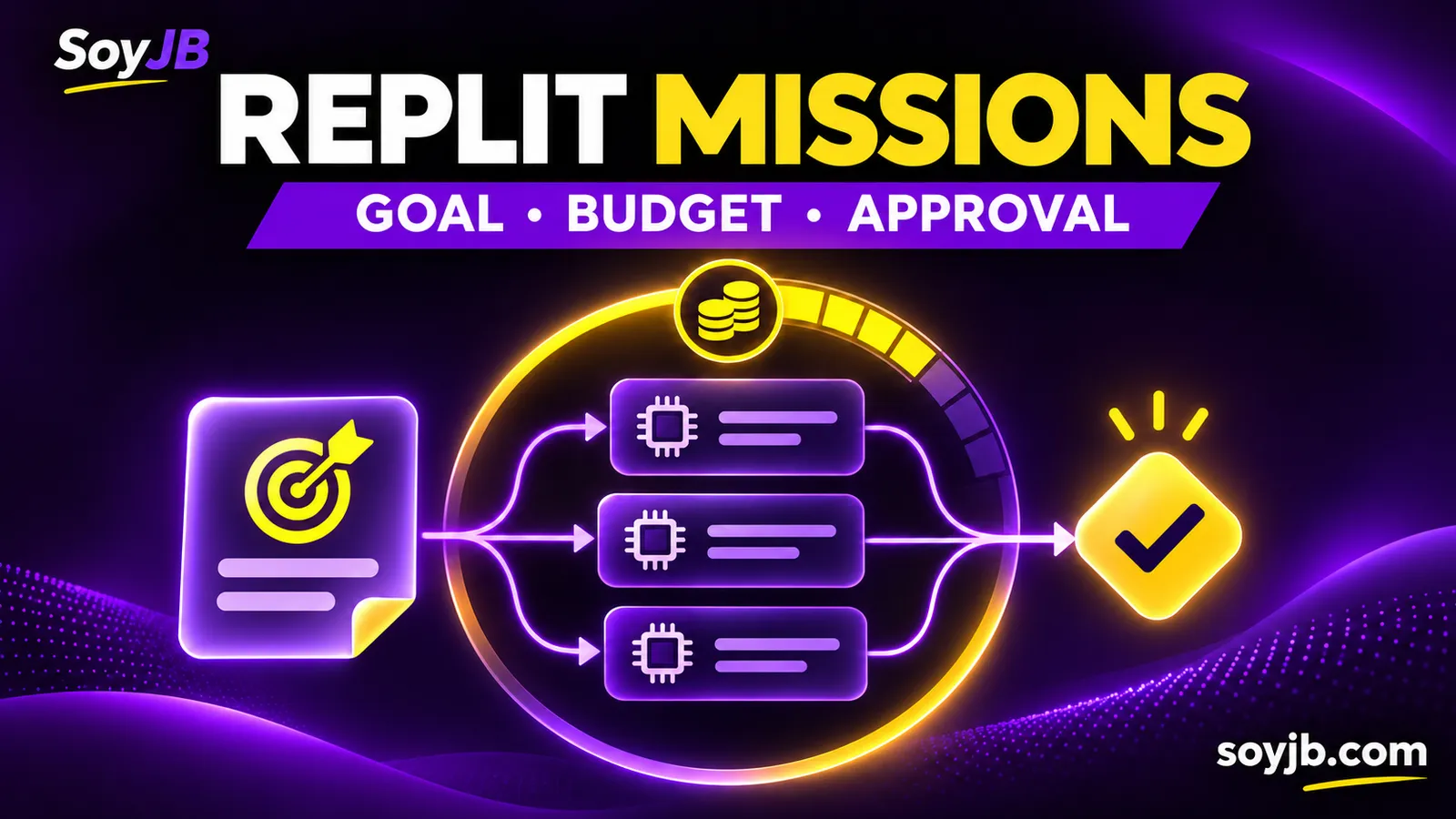
“Improve checkout conversion” sounds like a good goal for an agent swarm. Without a measurable outcome, though, it can become a bill and a pile of changes nobody can assess. Replit launched Missions on November 17, 2026: agents that plan, build, test, and iterate toward a defined outcome within a user-set budget and boundaries. The useful shift for a founder is specifying the result and requiring approval for consequential actions. This week's test should start with the mission agreement, before spending on a long run.
What Missions actually does
Replit says setup asks what success means, coordinates parallel work, and shows active tasks, spending, and blockers. An AI judge checks work against the agreed criteria. If the budget runs out, the work stops even if the goal is unresolved. You can require permission before contacting prospects, publishing a page, changing prices, or making customer commitments. The product page shows one shared budget across agents and explicit approval for a higher limit.
Replit reports building its own DataCat monitoring platform in two days within a $3,000 budget. That is a vendor case study with its own test conditions, not a forecast for your project. An AI judge is also not an independent audit. You still need to inspect the diff, tests, business data, and consequences of deployment.
Draft a mission agreement first
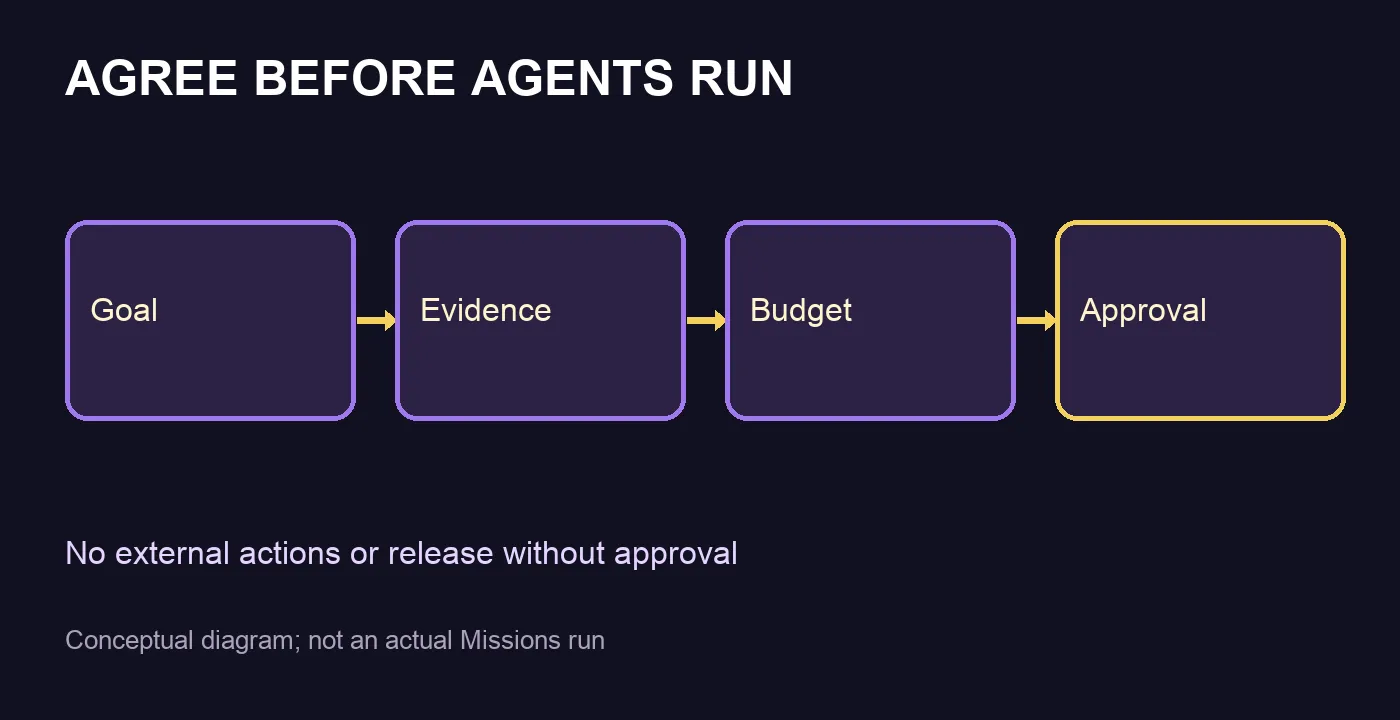
Before selecting New → Mission, write down a bounded job. For example, investigate a mobile signup failure and prepare a reviewable fix. Define success around evidence the agents can actually produce in a short run, rather than a sales number outside their control:
Goal: reduce reproducible mobile signup errors.
Scope: form and tests; no billing or production data changes.
Evidence: 3 reproducible cases, root cause, PR, automated tests.
Success: all 3 cases pass and a person approves the diff.
Spending limit: amount chosen and confirmed in the UI.
Approval required: data access, deploy, customer messages,
                   price changes, any budget increase.
Stop: halt when the budget is spent or evidence is missing.
This is a planning template, not a Missions command or a claim that we ran one. Adapt the budget to what your account offers. A tiny change, such as editing one label, may be easier with a regular agent. A job needing several approaches, tests, and iterative review is more plausible for a swarm.
Test it while keeping control
- Check whether
Missionappears in your Replit workspace and inspect applicable pricing. The announcement describes a sidebar entry but does not specify every eligible plan or a universal per-mission price. - Enter the goal, then review every success criterion, spending limit, and approval rule before execution. Reduce scope if the proposed work expands beyond the problem.
- While it runs, compare spending with evidence delivered. A polished screenshot or a test written by the same agent does not prove that the flow works for real users.
- Before approving a change, run your own checks and review security, accessibility, and data handling. Retain the option not to deploy.
The practical decision is whether Missions produces enough reviewable evidence for its cost while a person controls external actions and production releases. We did not run Missions or spend Replit credits. Its capabilities and DataCat case are Replit's claims. Plan eligibility, effective cost, and output quality on your repository remain unverified.
Sources: Replit announcement, Nov 17, 2026; official Missions page; plans and pricing.