
A researcher can ask Claude to clean a dataset or draft a report in minutes. That does not mean it has identified the question worth studying. An Anthropic report published November 5 analyzes 207,049 scientific Claude and Claude Code sessions and finds far more use in analysis and writing than hypothesis generation. For a founder or creator, the transferable idea is a working hypothesis: automate production, but reserve an explicit step for deciding which problem deserves attention.
What Anthropic actually measured
The original report classified consumer-plan sessions from August 2 to September 30, 2026, using privacy-preserving methods that kept aggregate labels rather than open-ended research content. Its main sample includes 128,914 Claude sessions and 78,135 Claude Code sessions. A classifier assigned a field and research task based on a taxonomy. This describes use of these products among users; it does not measure productivity, quality of discoveries, or every scientist worldwide.
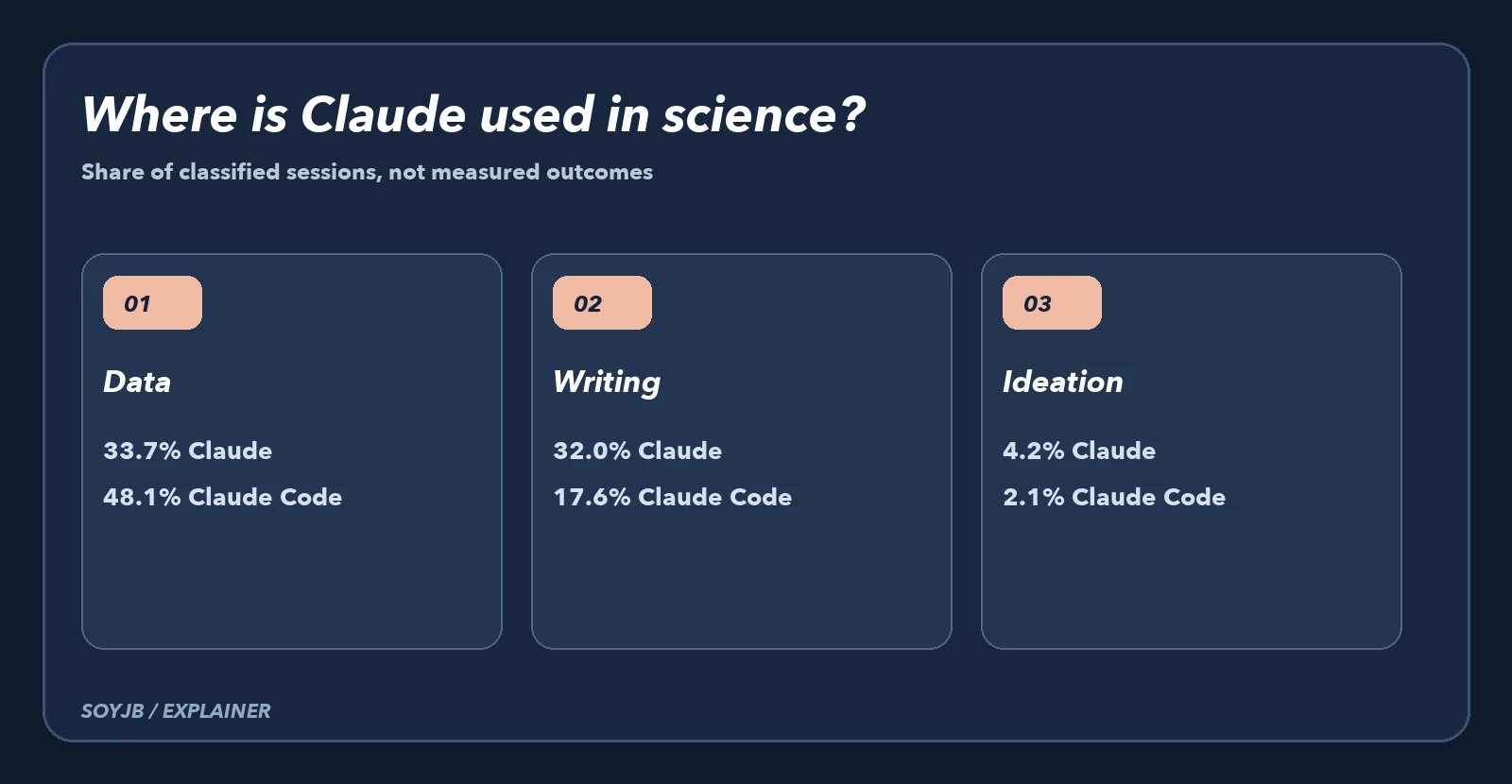
Data analysis accounts for 33.7% of scientific sessions on Claude and 48.1% on Claude Code. Writing and communication account for 32.0% and 17.6%. Ideation and hypothesis generation appear in 4.2% and 2.1%. In a supplementary survey of 528 scientists already using AI, respondents ranked ideation and hypothesis generation as most important for producing a meaningful result, despite using AI for it less often. That is a gap between reported importance and observed frequency, not proof that Claude cannot help generate ideas.
Why a creator or product team should care
Applying this to content creation or product discovery is a SoyJB inference, not a finding measured by the report. Both fields make it easy to optimize visible output: drafting a post, producing a chart, polishing a deck. The upstream selection step can be neglected: which user question is worth answering? If the question is weak, faster prose merely scales a weak decision.
Run a small test with real work. Before requesting an article, collect five concrete questions from customers, comments, or search data. Ask Claude to organize evidence and unknowns, not to pronounce the “best idea” by authority. A person on the team chooses the topic using user pain, testability, and usefulness of the answer. Then use AI to analyze data, check sources, and draft a reviewable explanation. Measure whether the result helps someone decide, not only how quickly the words appeared.
Context: [product, audience, and goal].
Observed real questions: [paste five with source and date].
For each question, separate:
1. Available evidence and its original URL or record.
2. What is unknown and how we could check it.
3. A decision a reader could make from the answer.
4. The risk of inventing a fact or overpromising.
Do not pick a topic automatically. Return a table for the team to prioritize.
This prompt is a SoyJB workflow proposal; Anthropic did not evaluate it in this study. For public content, verify the original sources and do not treat the table alone as evidence of market demand. A question repeated in five comments may be worth testing, but it does not represent the entire market.
What the study cannot establish
Claude sessions do not show all the time researchers spend on each task outside the tool. Automatic classification may miss ideation embedded in analysis or writing; Anthropic acknowledges that possibility. The accompanying survey focuses on active AI adopters, primarily in life and health sciences. The report's estimates of possible scientific output growth are hypothetical scenarios, not observed gains or a promise for a blog or startup.
The practical decision is to create two steps in your workflow: choose an evidence-backed question with human judgment, then delegate analysis and drafting with verification. Keep the process if it improves the quality of decisions your audience can make. If it only increases the number of posts, value is still unproven.