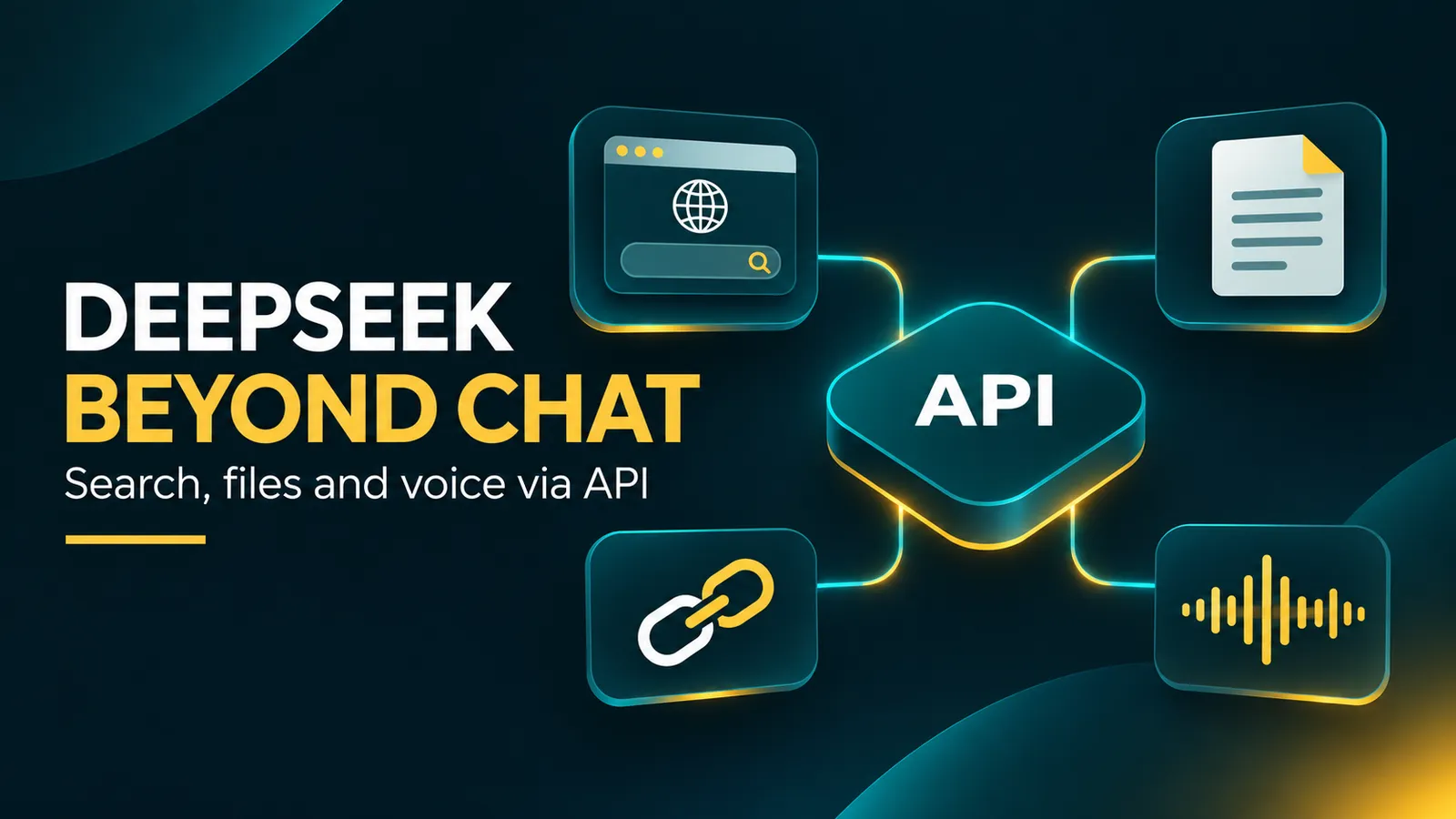
Suppose your product answers questions about documents and current supplier information. Until now, that often meant stitching together a model, search provider, page reader, file parser and perhaps a voice service. On November 13, 2026, DeepSeek announced that these capabilities are available through its API. The decision for a small team is whether a single platform makes a prototype simpler, and what each useful conversation actually costs.
What DeepSeek released
The announcement covers web search, URL reading, file input, safety checks, speech recognition (ASR), text to speech (TTS) and OCR. With deepseek-flash, a chat application can declare deepseek_web_search and deepseek_read_url and let the model decide when to use them. Separate search and fetch endpoints remain available when you need to control retrieval yourself. DeepSeek publishes a chatbot guide and open source demo. Their existence documents availability; we have not run a quality benchmark on a live account.
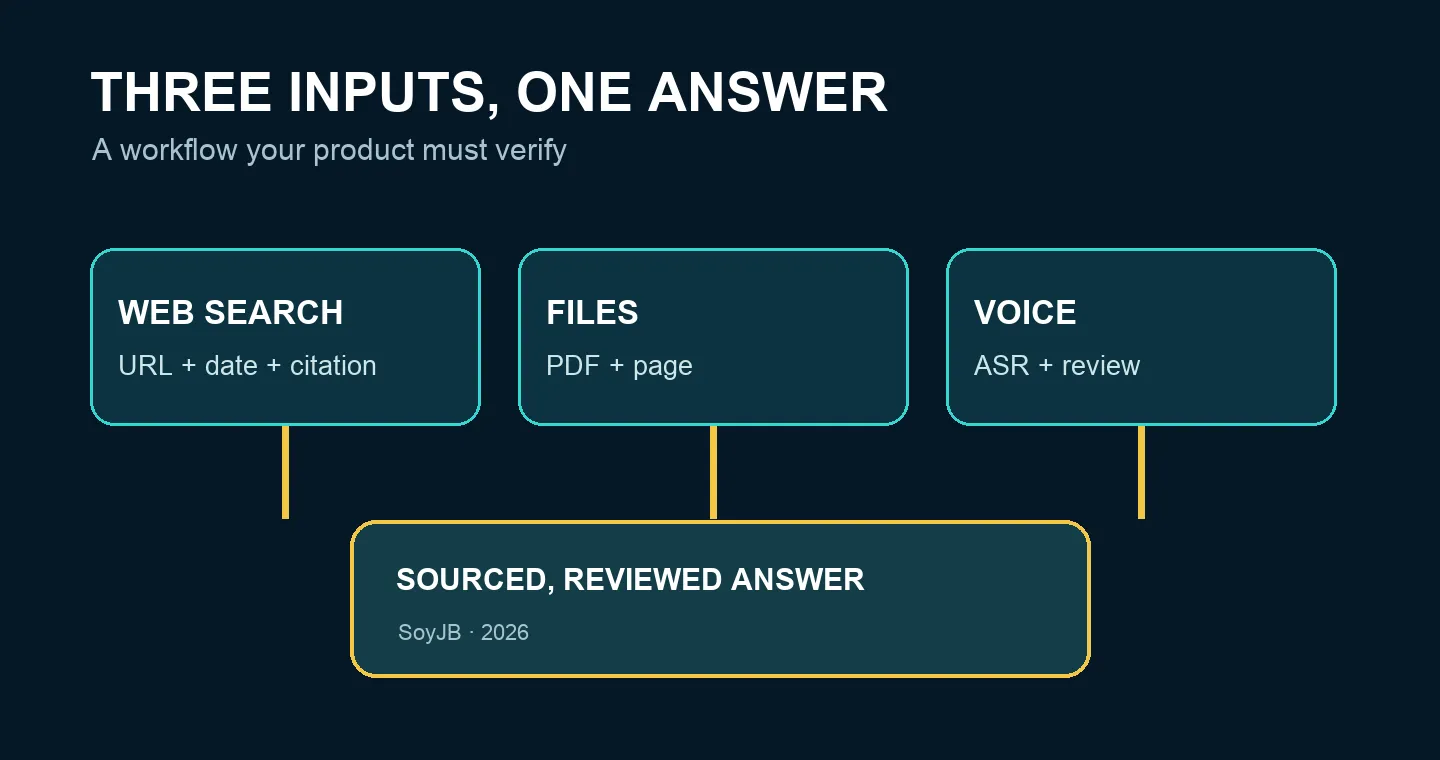
That distinction matters in practice. A vendor comparison assistant could read three official pricing pages and return citations. A support assistant could answer from an uploaded PDF and identify its source. A creator tool could transcribe a voice memo and read a response aloud. None of those flows is reliable by default: your application still needs permissions, failure handling, source review and a human check for consequential decisions.
A bounded test to run this week
- Pick a question your team can independently answer, such as “What changed in this supplier’s pricing this month?” Save the correct answer and original URLs first.
- Ask once without search and once with
deepseek_web_search. Check whether the response cites original pages, identifies the document date and keeps different plans separate. - Send a specific link using
deepseek_read_url. Treat an inaccessible or stale citation as a failed answer. - If the use case needs PDFs or audio, test one file you have permission to use. Check extraction errors, language handling and data treatment before uploading sensitive material.
- Record tokens, search and fetch counts, latency and correct answers per call. Compare the same questions with your current workflow before replacing it.
For a public-facing service, DeepSeek's documentation says to enable safety_check and reminds developers of their own content review and labeling responsibilities. Its demo stores the API key and conversations in the browser for demonstration. Keep your production key on the server and define who may invoke paid tools.
Token price is only part of the bill
The official rate card checked November 15 separates peak and off-peak hours, cache hits and tool use. Flash input without a cache hit costs US$0.15 per million tokens off-peak or US$0.30 at peak; output costs US$0.60 or US$1.20. Search and web fetch each cost US$0.75 per 1,000 operations on top of tokens. OCR and file parsing are listed at US$0.225 per 1,000 pages. ASR currently has a limited-time US$0.058-per-hour rate against a US$0.116 list price. Rates can change.
Here is an illustrative calculation, not measured spend. A thousand conversations making two searches and one fetch each would spend US$2.25 on web tools alone. If each conversation also used exactly 2,000 uncached input tokens and 500 output tokens on Flash off-peak, model tokens would add US$0.60, for a theoretical US$2.85. Extra searches, fetched-page tokens, retries, files and other charges raise that figure. A multi-step research answer may be much more expensive. Track cost per correctly answered task rather than choosing from a token price alone.
The decision
If your current prototype maintains several services for one simple task, test the integrated flow against 20 real questions. Compare accuracy, citations, latency and spend with your existing stack. If auditability or retrieval control is critical, use the standalone endpoints and decide which pages reach the model. DeepSeek has expanded its API; adopting it still requires a test with your own data, permissions and spending limits.
Sources: DeepSeek announcement, November 13, 2026; official chatbot guide; official pricing; search and fetch APIs.