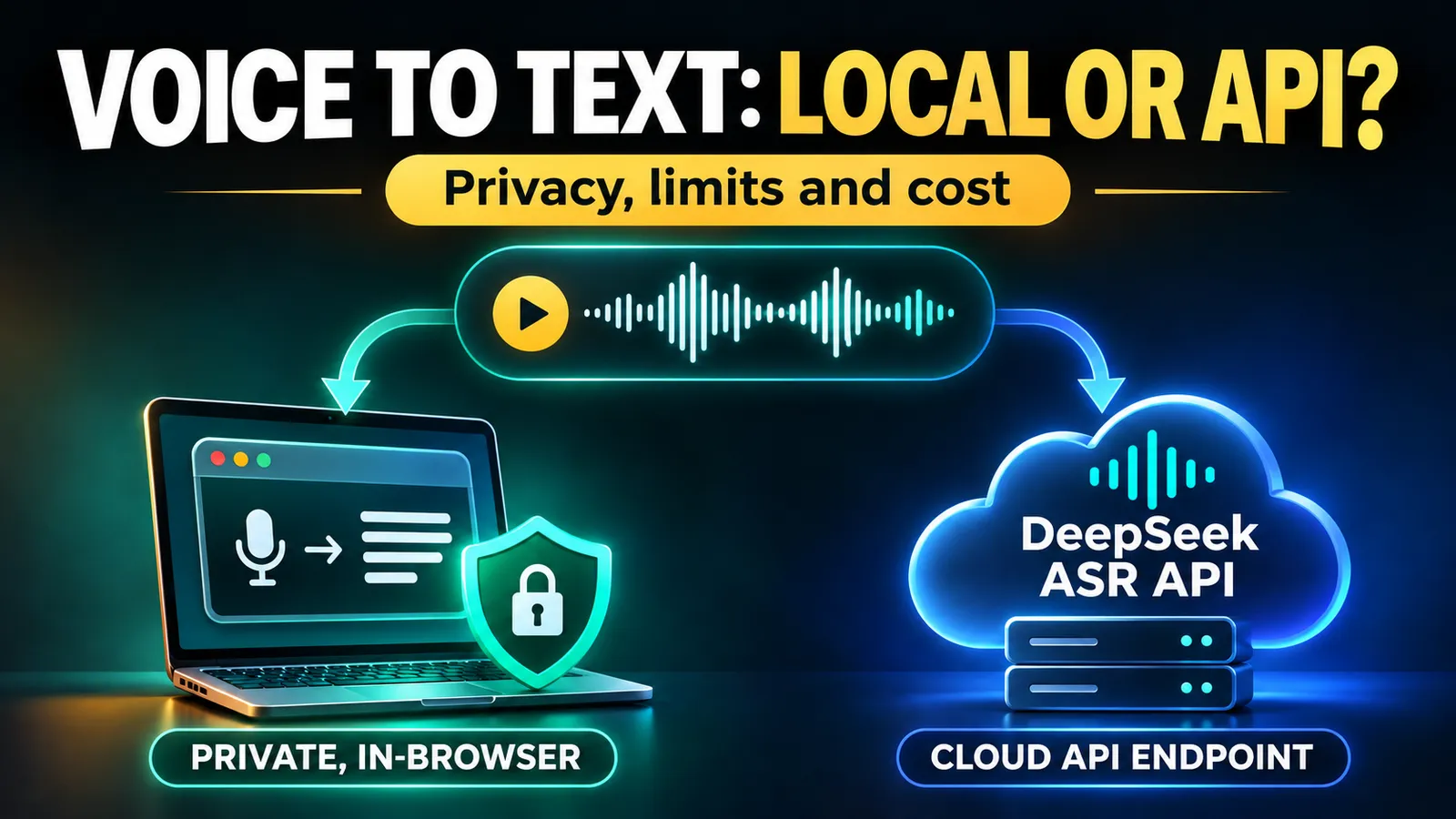
A creator records a 90-second voice memo for the next video. They need a transcript today, but might also want to process hundreds of recordings every week. Those are different jobs: a private one-off recording may be easier in a browser, while an app that accepts user uploads needs an API. DeepSeek's newly documented speech-to-text endpoint makes the trade-off concrete: privacy, automation, file limits and price.
Make the choice quickly
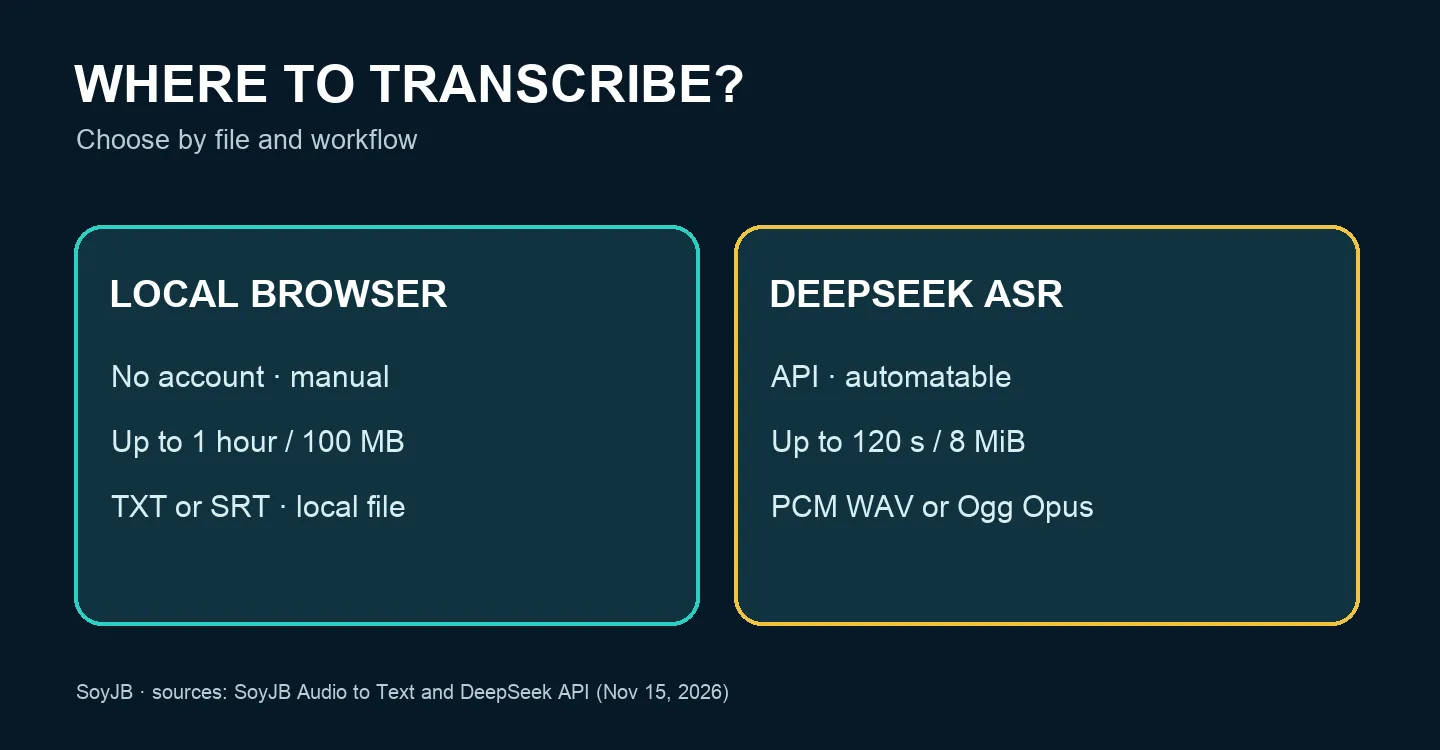
Use a browser workflow if you transcribe your own recordings manually and want the audio to stay on your device by default. SoyJB's Audio to Text tool says its local mode needs no account, accepts MP3, WAV, OGG, M4A, FLAC and WebM, and supports files up to one hour and 100 MB. It can export TXT or SRT. Its optional server mode has different privacy and quota implications.
Use an API when your product must receive an audio file and return text automatically. DeepSeek exposes POST /v1/tools/asr, bills by audio duration and returns the complete transcript when processing ends. Its current per-request ceiling is 120 seconds and 8 MiB. It accepts 16-bit PCM WAV or Ogg Opus and does not support streaming recognition. For stereo audio, it recognizes only the left channel. Language detection is automatic, with English and Spanish among the supported languages. Those limits matter for interviews, podcasts and meeting recordings.
A reproducible test with a recording you own
Use a 30–90 second recording you are allowed to process, without sensitive information. If your phone produced M4A, convert it locally to mono 16-bit PCM WAV at 16 kHz with FFmpeg. Run this in a terminal after replacing the filename:
ffmpeg -i memo.m4a -ac 1 -ar 16000 -c:a pcm_s16le memo-16k.wav
ffprobe -v error -show_entries format=duration,size -of default=noprint_wrappers=1 memo-16k.wav
Check that duration is no more than 120 seconds and size is no more than 8,388,608 bytes. Conversion stays on your computer. The next command would send the file to DeepSeek and requires an API key with credit. Put the key in a terminal environment variable, never in source code or a screenshot:
export DEEPSEEK_API_KEY='YOUR_PRIVATE_KEY'
curl -fS https://api.deepseek.com/v1/tools/asr \
  -H "Authorization: Bearer ${DEEPSEEK_API_KEY}" \
  -F 'file=@memo-16k.wav' \
  -o transcript.json
cat transcript.json
The official ASR guide shows a JSON response with request_id, text and duration_ms. Review names, numbers and negations against the recording. The documented response does not promise SRT or word-level timestamps, so do not assume it can produce synchronized captions. The browser tool's SRT export is a separate option when captions are the deliverable.
Handle failures before scaling
A 400 usually means an unsupported format or missing file field; 413 means the file exceeds 8 MiB; 429 means too many concurrent requests; 503 and 504 indicate a busy service or timeout. DeepSeek currently allows at most 50 requests in progress per account. Log the request ID and file size, while keeping audio and API keys out of shared logs. Splitting a long recording into chunks is an application-level workaround, but sentence boundaries, ordering and retries make it a separate engineering task. Test it before advertising hour-long transcription.
What one memo costs
DeepSeek's rate card checked November 15 lists a limited-time ASR rate of US$0.058 per hour against a US$0.116 list rate. It bills audio duration rounded up to the second. A two-minute memo would cost about US$0.00193 at the promotional rate, before other services. A hundred two-minute memos would be about US$0.193. These are calculations, not measured spend; check the current price before budgeting. SoyJB's local mode has no API bill, but it uses your device's time and compute.
For a first decision, transcribe the same permitted recording both ways and compare corrected words, elapsed time and output format. Keep sensitive audio local if you lack permission to send it to a third party. If you build a user-facing upload feature, document consent, retention and spending controls before automating it.
Sources: DeepSeek's November 13 announcement; official ASR guide; official pricing; SoyJB Audio to Text specifications. We checked the FFmpeg conversion syntax locally with a test file; we did not make a paid DeepSeek call or measure its recognition accuracy.