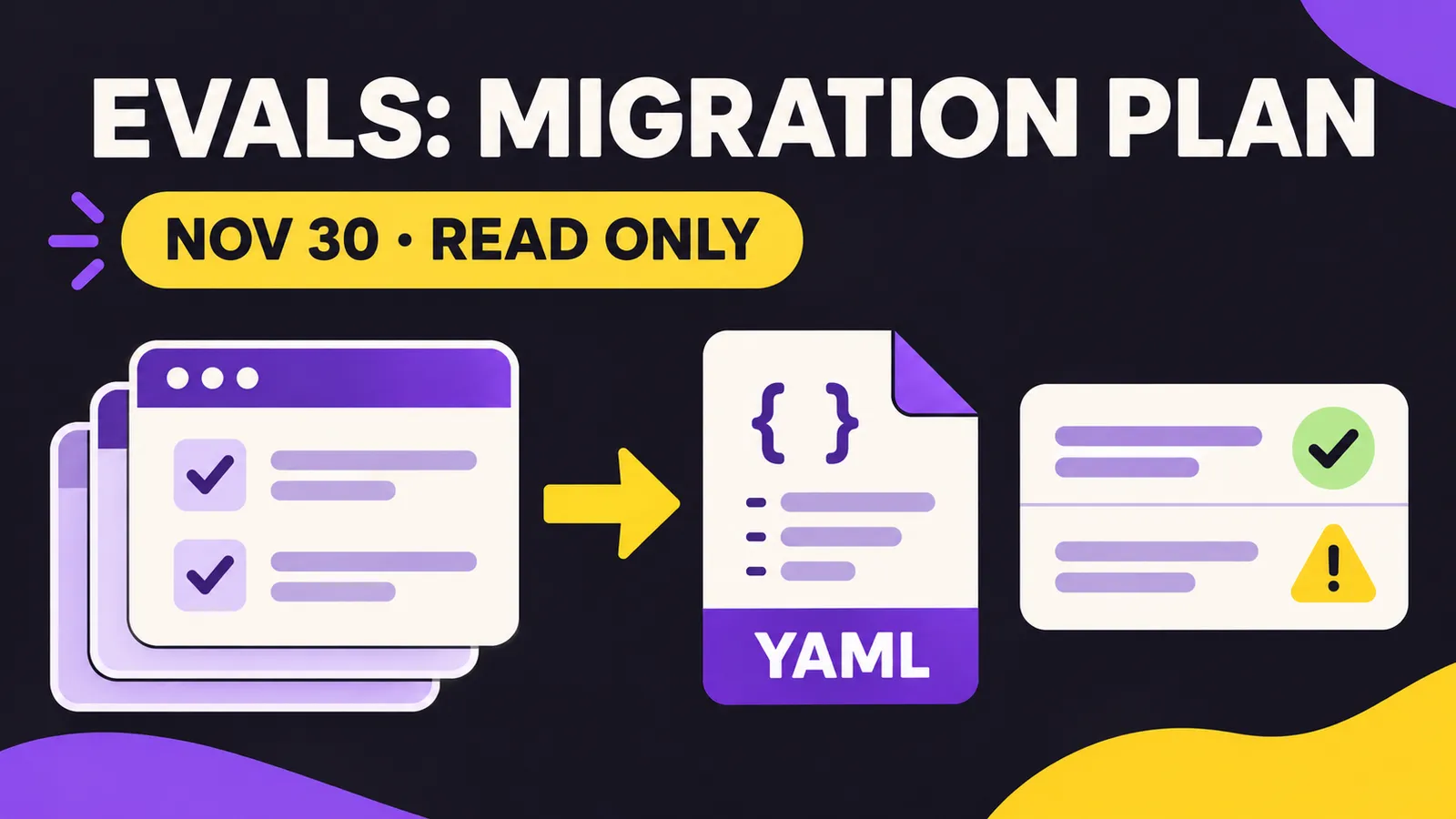
If your assistant's quality checks live in OpenAI Evals, put a migration check on this week's calendar. OpenAI's official deprecations table says the Evals dashboard, API and graders for evaluation workflows become read-only on November 30, 2026. The notice dates to June 3; this is an upcoming deadline, not a product launch today. OpenAI recommends recreating these evaluations in Promptfoo.
A useful first move is to preserve the behavior your tests guard, not simply swap one dashboard for another. I tested a small local Promptfoo configuration with its echo provider. It checked two fictional support answers: one valid and one that violates a refund rule. No OpenAI API key, paid inference or real customer data was used. This does not claim to migrate an actual OpenAI Evals project.
What the read-only change means
Read-only does not mean that your historical results disappear on November 30. It means the affected Evals workflow stops being a place to create and run new evaluations. OpenAI's migration guide recommends manually rebuilding an evaluation as a portable configuration that runs locally or in CI. It does not require an Evals export feature and does not promise identical scores for recreated graders.
Before switching tools, record four ingredients from each existing eval: test cases, the prompt or application under test, the provider/model and the pass criteria. For a customer-support bot, keep both a correct refund-policy answer and a reply that makes a promise your business cannot honor. Without cases and expected behavior, a new tool cannot preserve your regression signal.
Validate the wiring without an API call
Install Promptfoo using npx promptfoo@latest or its installation guide. Current documentation requires Node.js 22.22.0 or newer; check with node --version. In a scratch directory, save this fictional example as promptfooconfig.yaml.
description: Check imported support answers
prompts:
  - '{{logged_output}}'
providers:
  - echo
tests:
  - description: Correct refund answer
    vars:
      logged_output: 'Refunds are available within 30 days.'
    assert:
      - type: contains
        value: '30 days'
      - type: not-contains
        value: '100% guaranteed'
  - description: Unsafe refund promise
    vars:
      logged_output: 'Every customer gets a 100% guaranteed refund.'
    assert:
      - type: contains
        value: '30 days'
      - type: not-contains
        value: '100% guaranteed'
Run these commands from the same directory:
npx --yes promptfoo@latest validate config -c promptfooconfig.yaml
npx --yes promptfoo@latest eval -c promptfooconfig.yaml --no-cache
The echo provider returns the prompt as output without calling a model. In my local run, Promptfoo 0.126.0 validated the configuration and reported one pass and one fail, with zero provider errors. The eval command exited with code 100 because I deliberately included a failed test. That is useful for a CI gate; it is not an installation error. If both examples passed, the rules would have missed the false promise.
Move from a toy check to your production eval
- Rebuild the cases: bring over representative examples from your old eval under your organization's data permissions. Keep versioned expectations. Do not commit customer data to a public repository.
- Translate the grader: a literal rule may become a deterministic
containsassertion. A semantic or model-based grader needs its own setup and validation; it may call a paid provider. - Replace echo with your app or model: this example only checks configuration and assertions. Follow Promptfoo's provider documentation for credentials and cost controls. Start with a small sample.
- Compare case-level decisions: inspect which examples changed from pass to fail and why. OpenAI warns that similarity scores and recreated graders may differ across systems.
- Keep the new workflow maintainable: version the configuration with your app, run it in CI when useful and retain results according to your data policy.
Limit: passing this local echo test does not migrate your OpenAI Evals data or establish equivalent grading. It is a reproducible first step to keep the rules working before the read-only deadline. The same OpenAI table also lists separate November 30 changes for /v1/prompts and Agent Builder; audit those independently if your app uses them.
Sources: OpenAI deprecations, OpenAI Cookbook migration guide and Promptfoo echo provider documentation.