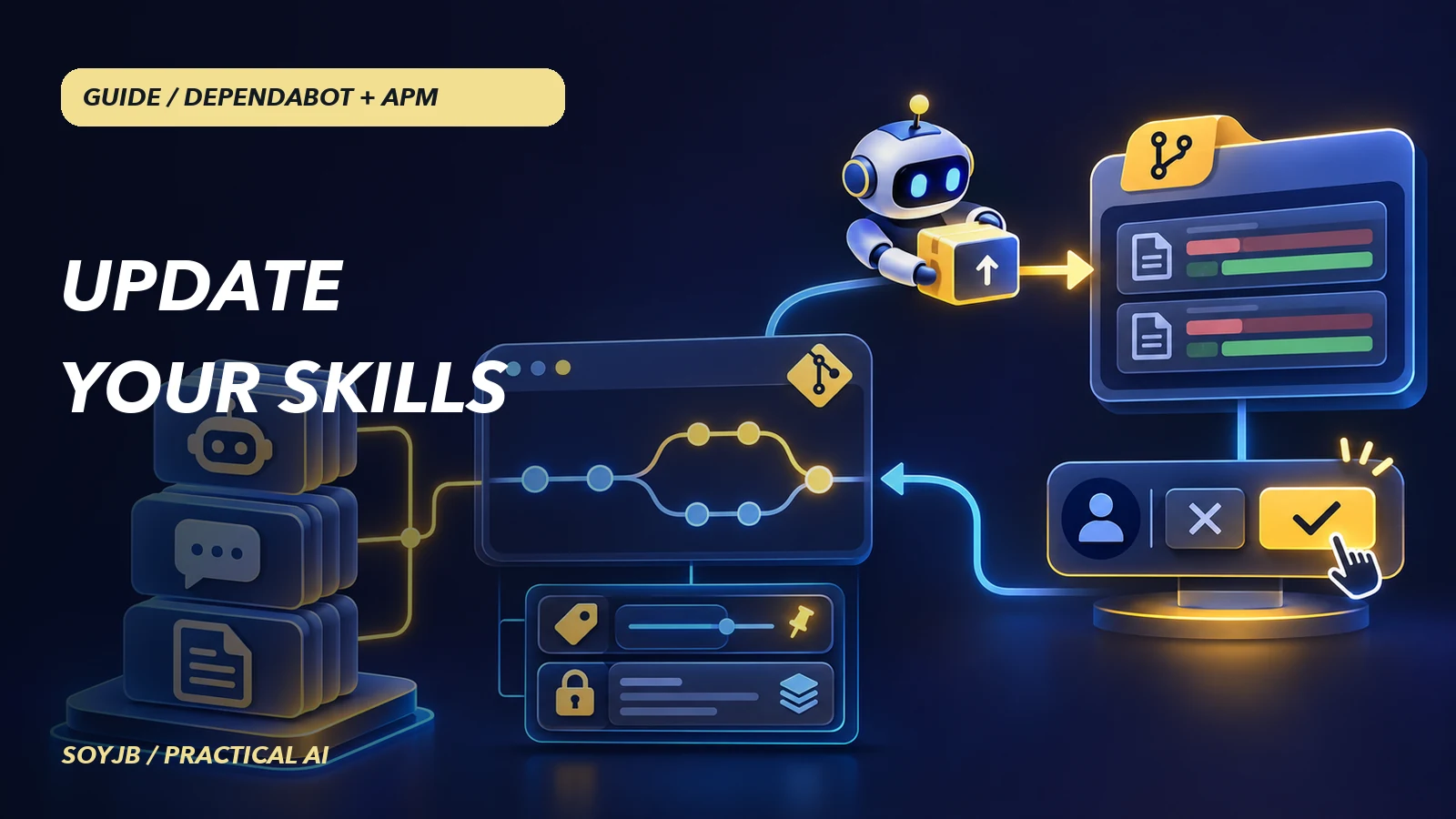
A code-review skill you copied six months ago still tells your agent to ignore the same failure that now costs you customers. Updating it manually across five repositories is easy to forget. Automatically merging every update can be worse, because a skill changes an agent's instructions. GitHub now offers a middle path: Dependabot can open a PR when an Agent Package Manager (APM) dependency changes, and you decide whether the new behavior belongs in your project.
GitHub's November 3, 2026 announcement says Dependabot can update git dependencies in apm.yml and regenerate apm.lock.yaml when present. This is generally available on github.com for all plans. It covers version updates, not automated APM security alerts or security updates.
When APM is useful
APM manages dependencies for agent skills, prompts, instructions, and related components. Its documentation says the manifest lives in apm.yml, while apm.lock.yaml records the resolution generated by apm install. If your team shares a versioned skill across repositories, declaring its source avoids disconnected copies. If you only have one local instruction that you never distribute, a package manager may add unnecessary work.
A minimal versioned-skill setup
Declare a dependency at the project root. Replace OWNER/agent-skills with a repository you trust and a real tag published by its maintainer:
# apm.yml
name: my-agent-project
version: 1.0.0
dependencies:
  apm:
    - OWNER/agent-skills#v1.0.0
Then add a Dependabot configuration. directory: "/" tells it where to find apm.yml; adjust the path if your manifest lives in a subdirectory:
# .github/dependabot.yml
version: 2
updates:
  - package-ecosystem: "apm"
    directory: "/"
    schedule:
      interval: "weekly"
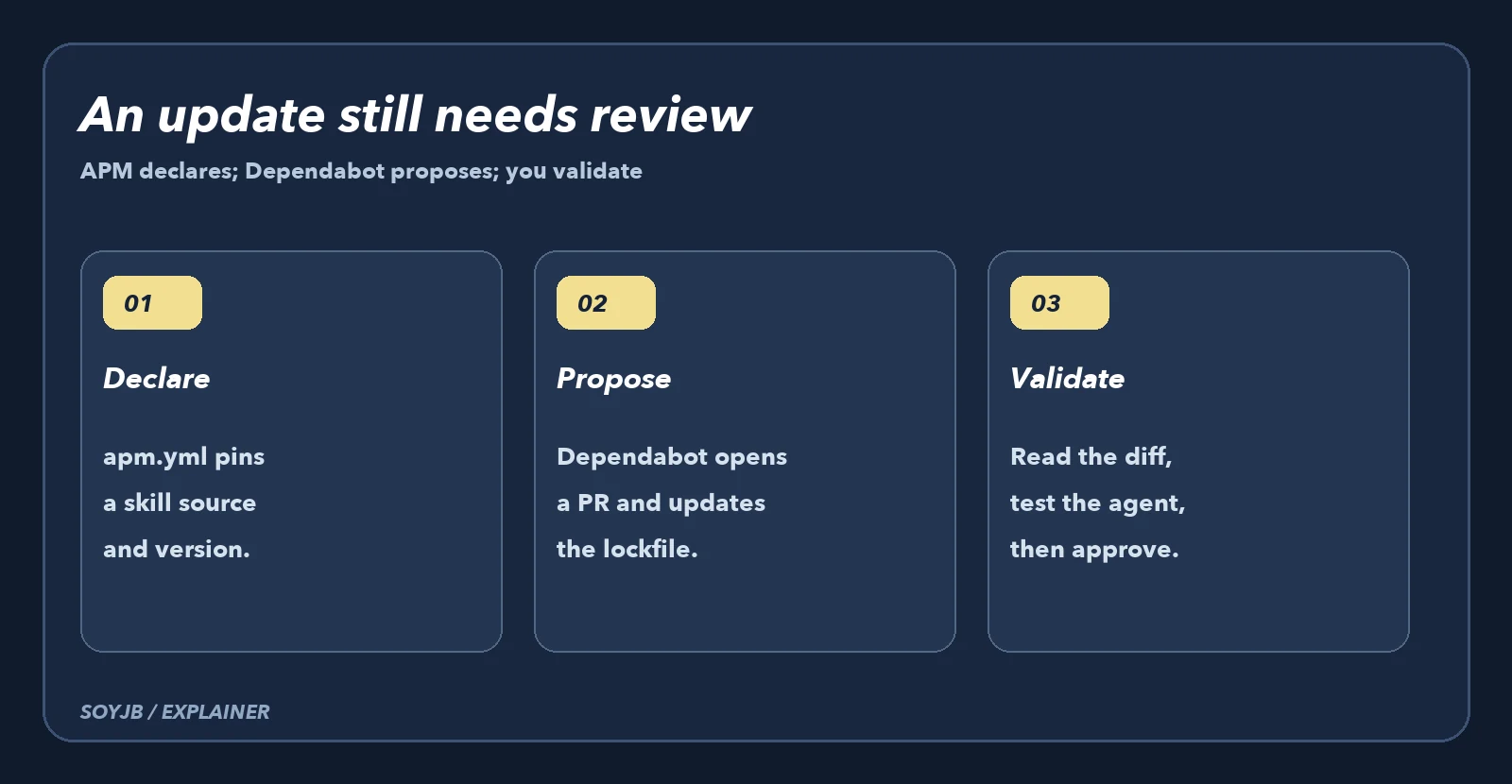
Run apm install in your environment to generate the lockfile, then commit both the manifest and generated file. GitHub's support reference says Dependabot checks dependencies.apm and devDependencies.apm. A SemVer tag can advance to a newer tag; a branch reference moves to its latest commit; a commit SHA is updated to the commit of the latest annotated non-prerelease release tag. Understand that policy before you choose a reference, especially for an agent with broad permissions.
Review the first update PR
- Confirm that the PR changes the intended source and version, and that the lockfile agrees. Do not edit
apm.lock.yamlby hand: APM generates it. - Read the skill diff, including instructions, tool access, permissions, and transitive dependencies. A “text-only” change can still expand what the agent tries to do.
- Run one fixed test case against the old and new versions: for example, a small PR with a fake secret or broken input validation. Record whether the skill catches the issue without creating noise.
- Keep human review and avoid auto-merge for instruction updates that can act on code, data, or external services.
The two YAML blocks are structural examples validated locally as YAML. SoyJB did not install APM or open a real PR; those actions require a repository and a dependency chosen by the reader. GitHub confirms APM git-dependency version updates but not APM security updates. This guide establishes a review loop, not a guarantee that a third-party skill is safe.
Decide whether the extra system pays for itself
Imagine a shared skill that reviews signup forms. If three products consume it, a versioned dependency gives you a clear benefit: a fix to the skill can be proposed to each product as its own PR, and each team can check whether the new behavior fits. If the skill belongs to one project and changes alongside its code, keeping it directly in that repository may be simpler. APM does not make every instruction file a dependency that needs an update bot.
Before adopting the workflow, define one acceptance case: “The skill must notice that a form loses its message after a 429, and it must not edit payment routes.” Save the prompt, small test project, and expected outcome. When Dependabot opens a PR, run that same case with the old and candidate versions. Investigate if the outcome changes. If it does not, still inspect permissions and transitive dependencies. This comparison gives you better evidence than a version number or a reassuring PR title.
Finally, separate routine version maintenance from security response. Dependabot's APM support does not include security updates. A compromised or malicious skill is not made safe simply because weekly PRs appear. Control the source, inspect changes in maintainer or repository ownership, and treat a prompt with tool access as code that deserves review.
Sources: GitHub Changelog, Nov 3, 2026; supported behavior; APM documentation. Reviewed Nov 7, 2026.