A user requests an AI-generated report that takes several minutes to fetch data, draft text, and store a result. If the entire job runs inside the web request, the page waits and a retry may duplicate work. A queue consumer can process the job while the API creates it and reports its status. On October 30, 2026, Vercel added a useful connection for that architecture: Daemons can now call private services in the same deployment through service bindings.
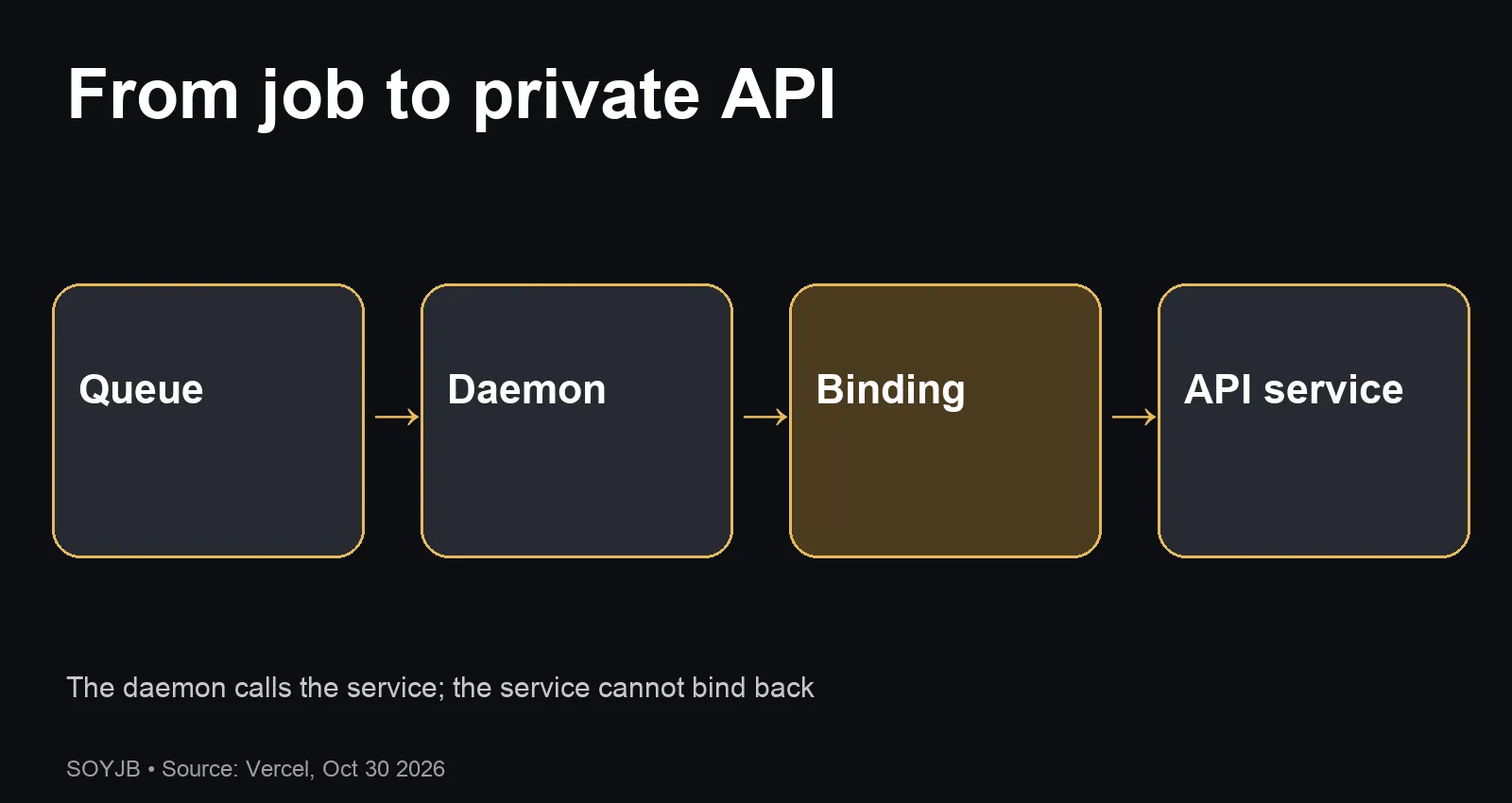
In Vercel's announcement, the binding injects a service URL into the daemon as an environment variable. The worker makes a normal HTTP call; Vercel handles internal routing, authentication, and TLS. The service can stay private rather than being exposed solely for the worker. This is relevant to teams with continuous jobs, not a reason to start an always-on process for every short task.
What changes for an AI product
Picture an app that accepts a PDF and produces a reviewable summary. The web request records a job and returns an ID. A daemon pulls jobs from a queue, calls a private API for metadata or state updates, processes the document, and stores the result externally. The interface checks the ID for completion or failure. This keeps model latency out of the user's request path.
Vercel describes Daemons as persistent, pull-based processes that retrieve work from queues, databases, or third-party systems. They are in public beta. You choose an instance count; persistent filesystem storage is not part of the initial release, so jobs and results need external storage. A scheduled short task may fit a cron job better, while a multi-step process that waits and resumes after failure may need a workflow. Vercel's worker hosting guide distinguishes these models and notes that process restarts alone do not guarantee recovery of interrupted jobs.
The configuration to understand
Vercel's example places an api service and a worker daemon in vercel.toml. The binding names the target service and the environment variable that receives its URL. The central part, adapted to those names, is:
[services.api]
root = "api/"
entrypoint = "main:app"

[daemons.worker]
root = "worker/"
entrypoint = "Dockerfile"
instances = { iad1 = 1 }

[[daemons.worker.bindings]]
type = "service"
service = "api"
format = "url"
env = "API_URL"
Inside the worker, the URL is available as API_URL. The launch note illustrates a call like fetch(new URL('jobs/next', process.env.API_URL)). That demonstrates the connection only. Your endpoint still needs an application-level request method, response format, error handling, and job-state design. Copying the binding without a queue and a deployed service will not create a complete job system.
Related October 30 update: Vercel also added HTTP liveness probes for Daemons. The platform can restart a container when the process is still running but fails its health check. That helps identify a stuck worker; it does not replace per-job retries and idempotency.
A safe acceptance test
- Confirm that your project can access the Daemons beta and check pricing for your plan; the announcement does not provide one universal cost for this setup.
- Use a development queue and a disposable job whose status is stored outside the container.
- Verify that the worker receives
API_URL, can call the private service, and logs success and failure without exposing credentials. - Interrupt a job and inspect the queue behavior: does it redeliver, retry, or leave the job pending? Make the final side effect idempotent to avoid duplicates.
- Test a deployment or rollback during processing. Vercel says each daemon instance remains bound to the deployment that started it.
Bindings work in one direction: a daemon can bind to a service, but a service cannot bind to a daemon, according to Vercel. I have not deployed this sample in a Vercel account; the configuration is based on the official example, not a claimed live test. The decision for this week is specific: if your app already needs a continuous consumer and a private API, test the binding with one disposable job. If it needs only occasional work, compare execution models first.
Primary sources: Vercel announcement, October 30, 2026; Vercel worker guide, November 1, 2026; Vercel Daemons.