
Updated November 23, 2026. The original article described the first snapshot of the Binance theft, as of October 31. Since then Binance has published preliminary findings on the intrusion, U.S. authorities have obtained orders over some assets, and researchers have documented stolen funds entering mixers. The key distinction remains: tracing, freezing, restraining, replenishing customer reserves and returning stolen funds are different outcomes. Values move with transactions and market prices, so every figure needs a timestamp and source.
On October 29, Binance hot wallets lost assets valued at roughly $6.3–6.4 billion, depending on the valuation method. Binance reported about $6.34 billion affected; Elliptic estimated $6.43 billion. They are estimates of one incident, not separate thefts.
How the attackers got in and why the chain accepted withdrawals
Binance's preliminary November 3 report describes a months-long campaign that still awaits independent review. In June, a wallet operations engineer downloaded a tampered Homebrew installer while trying to install an AI coding tool. Binance detected the anomaly and replaced the device and credentials, but says the attacker had learned who worked on the wallet team. In September, another engineer went through fake recruitment interviews and downloaded a malicious “assignment” repository. That compromised computer opened a route into internal systems.
Binance says the attacker used an internal AI tool as a foothold on October 20, reached other engineers' machines, and found a token with container deployment permission. On October 29, stolen credentials and access to another engineer's computer led to the wallet signing service. This is the crucial boundary: a blockchain validates signatures; it does not know whether Binance intended the transaction. On Ethereum, the attacker used EIP-7702 authorizations to let an attacker-controlled contract act through a hot wallet. Pausing ordinary withdrawals did not automatically erase those on-chain authorizations. Binance later revoked them with a special procedure. Its report remains preliminary, and some technical findings will stay confidential.
Where the mixers entered the story
A mixer combines funds from multiple users to make the public link between an input and output harder to establish. It does not erase the ledger or make every investigation impossible. The early observation and later activity must be separated: before the theft, an operational wallet received small amounts of ETH from Tornado Cash to pay transaction fees. That alone did not show stolen billions entering the service. Later investigations did find stolen assets moving into mixing systems.
In Elliptic's November 23, 09:30 UTC snapshot, at least 3,930 BTC, about $247 million at that snapshot's price, had entered a CoinJoin round for the first time since November 1. Most of the mixed bitcoin was converted from stolen ETH, XRP and SOL. The 18,270 BTC stolen directly still sat unmoved in 19 addresses. Bitquery also documented roughly $7.7 million in SOL entering Privacy Cash on November 3–4 and ETH reaching Tornado Cash later. There is no evidence that the entire $6.3 billion went through one “blender.”
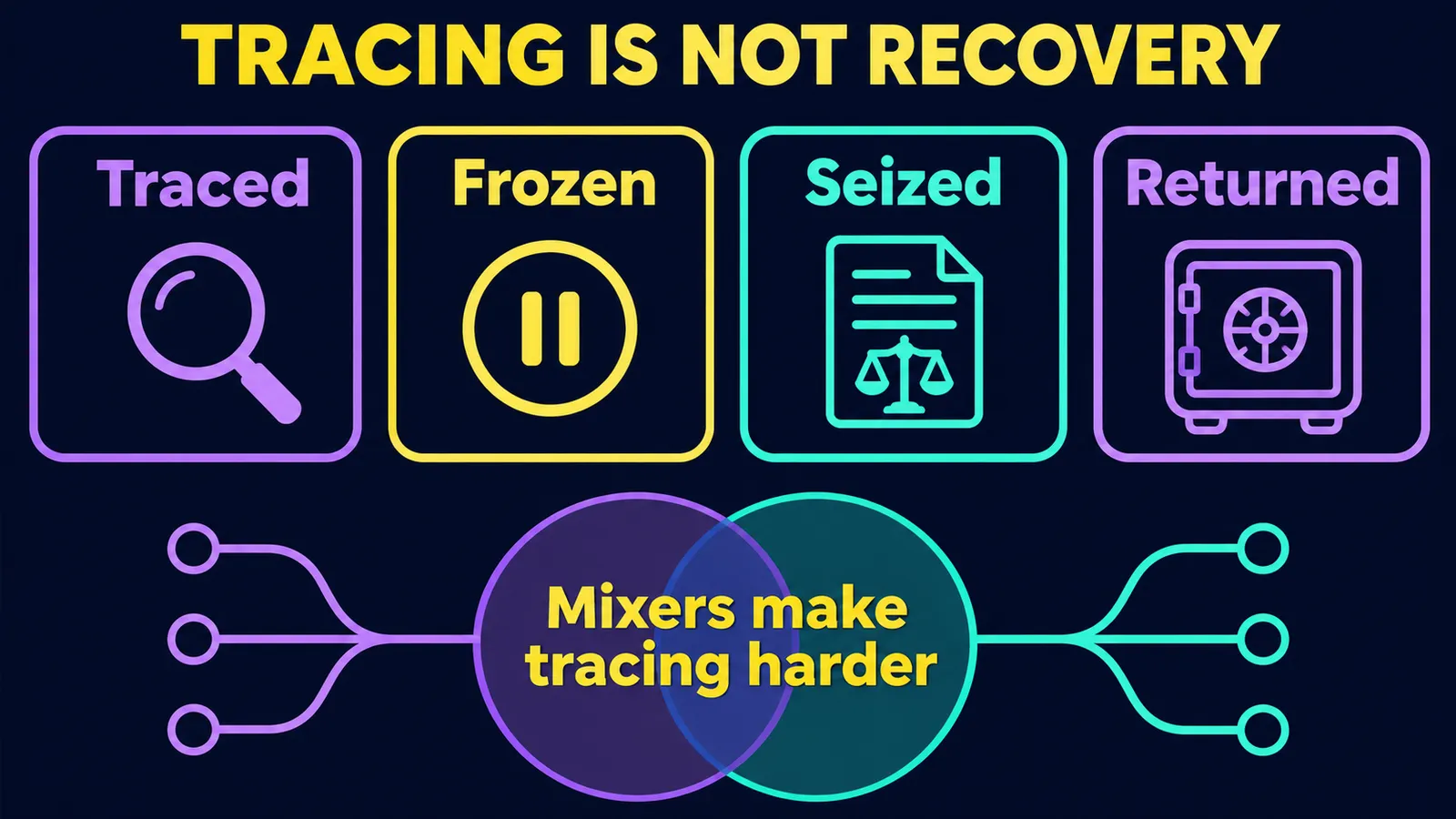
Why have the other roughly $3.5 billion not come back?
Subtracting about $2.85 billion frozen or intercepted from Binance's $6.34 billion affected gives roughly $3.49 billion. That may be what people mean by “the other $3.5 billion.” But it is not an exact current balance of recoverable or irrecoverable money: asset prices change, funds are swapped and split, and address ownership cannot always be established from a transaction alone.
Some stablecoin issuers can freeze their own tokens. Bitcoin and ETH have no equivalent central switch. Seeing coins at an address does not give investigators the private key. Swapping assets and chains, dividing funds among thousands of wallets, and using CoinJoin, Privacy Cash or Tornado Cash complicates the links across services. Elliptic estimated about $2.22 billion remained in addresses linked to the theft at its November 23 snapshot. That is not the full “missing amount,” and it must not be subtracted from the frozen figure as though both measured the same thing.
What was frozen, what was legally restrained, and how customers were covered
Binance says roughly $2.85 billion was frozen or intercepted and that it had replaced 100% of affected tokens by November 13 using corporate treasury assets, part of its SAFU reserve and part of its futures insurance fund. Its reserves update says the November 12 snapshot covered 198 tokens and that the zero-knowledge proof was generated November 14, allowing users to verify at least 1:1 backing. Replenishing customer reserves does not mean the attacker returned the stolen assets.
On November 12 the U.S. Justice Department reported more than $2.7 billion frozen through combined efforts and court authorization to seize or restrain more than $1.2 billion of that total. That is a subset of frozen funds, not an additional sum or proof of a transfer back to Binance. Binance says it obtained a separate Abu Dhabi court order on November 18 to support recovery with issuers and custodians. Such orders create a legal path to return; the process is ongoing. I did not find a publicly verified figure showing how much of the theft had actually returned to Binance control by November 23.
For readers, the lesson is to keep frozen assets separate from returned assets and replenished reserves separate from recovery. For builders of financial software, the case highlights the system that decides what to sign, deployment tokens and engineers' devices. Protecting private keys alone does not close the attack path. A final independent forensic report has not yet been published.
Primary sources: Binance preliminary findings (Nov 3); Binance reserves update (Nov 12–19); DOJ (Nov 12); Elliptic (Nov 23, 09:30 UTC snapshot); Bitquery (Nov 19 snapshot).