A Lovable app can move from idea to public link in an afternoon. The dangerous jump is assuming that “it works” means “each user can see only their own data.” A customer dashboard that reveals another account's row turns a demo into a data incident. On November 10, 2026, Lovable described what its security scanners check, which findings its agent can fix, and what remains the builder's decision. Use those controls alongside a three-identity test before you ship.
What the platform checks
Lovable says its publishing flow scans code, application logic, database schemas, and row-level security (RLS) policies. RLS controls which database rows a user can read or change. A deeper scan can be run on demand, and the Fix action asks its agent to address a specific finding. Auto-fix is a project setting; some teams can block a release with critical findings. None of these features proves that your particular app is safe or that a scan caught every access flaw.
An earlier Lovable explainer makes a practical distinction: the basic publish scan checks common configuration and access issues, while a deep scan examines more code and application logic. In the November 10 post, scheduled scans for all paid plans are described as coming later this month. Check your plan and UI before promising clients that a scheduled control is already running.
Test two users and one signed-out browser
Create test accounts A and B with no real personal data. Give each account a clearly named record, such as A-001 and B-001, in your app's main workflow. For file features, use harmless sample files. Write down the rule first: A may read and edit A-001 only; B may read and edit B-001 only; an anonymous session may access neither.
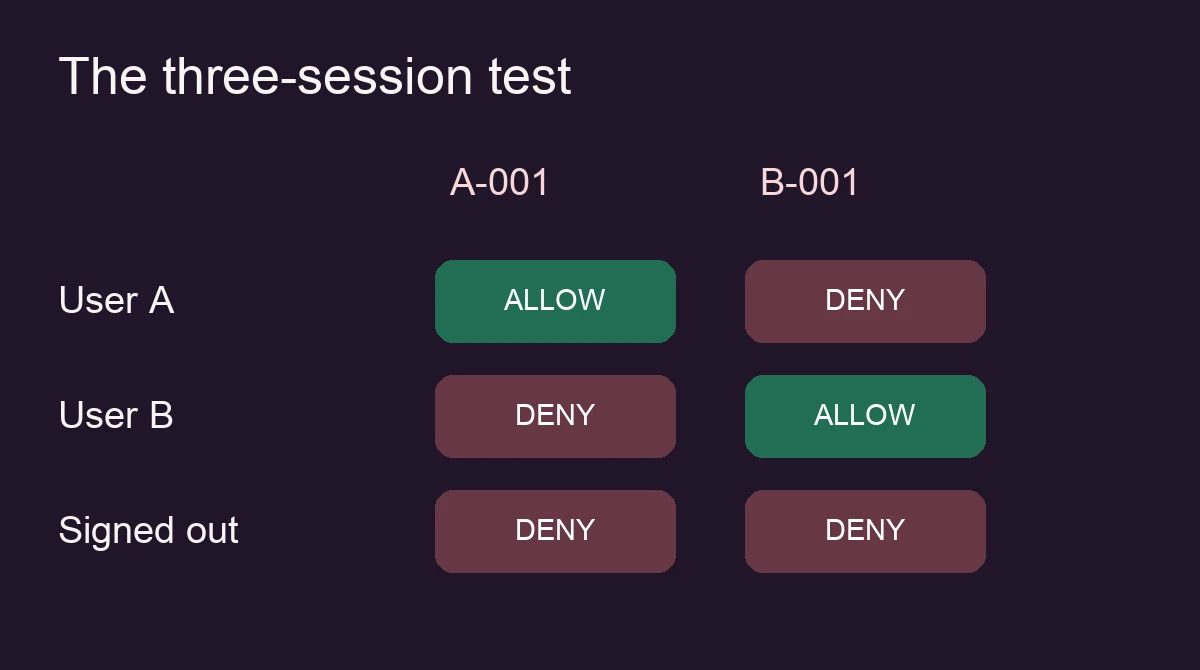
- Sign in as A in a normal browser window. Open and edit A-001, then copy its URL or visible identifier.
- Sign in as B in a private window and try A's URL. The server or database must deny both read and write. Hiding a button in the UI is insufficient.
- Sign out and try the same URL without authentication. The record and any private file must remain inaccessible.
- Reverse the test: A tries to read B-001. Record the date, test environment, fake accounts, expected outcome, observed outcome, and sanitized screenshots.
If B sees A's data, stop the launch. Inspect the table's RLS policy, the owner ID stored when rows are created, and server functions that may bypass or elevate permissions. Lovable's own founder checklist warns that enabling RLS is not the same as verifying its policies. Rerun both permitted and denied paths after using Fix or accepting any agent edit: a repair can close a leak while breaking legitimate access.
Finish the release gate
Run a deep scan before a public launch, when handling sensitive user information, or after significant architecture changes. Resolve critical findings and review warnings rather than dismissing them by habit. Check that third-party keys live in server-side secret storage and do not appear in JavaScript sent to the browser. Lovable provides platform protections and tools, but the builder still owns the app's access model and connected integrations.
A useful prompt for Lovable's agent, as a supplement to manual testing, is: “Review every user-data table and its RLS policies. For each table, state what user A, user B, and an anonymous session can read, create, update, and delete. Identify routes or functions that use elevated permissions. Do not change anything yet; cite the exact files or policies supporting each conclusion.” Verify its references in the project before making changes.
Ship only when scans have no unresolved critical findings, the three sessions behave as specified, and secrets stay off the client. This checklist does not replace a specialist review for high-risk systems. It is a reproducible protocol grounded in Lovable's documentation; we have not run it against Joseph's own Lovable app.