You want an assistant in your product. At first it answers a question about an order. Later it must wait for a person to approve a refund and keep going even if the page closes. Eventually it receives messages from several channels, enforces tool policies, and needs audit trails and evaluations. The product idea sounds continuous, but those stages create different engineering requirements. Choosing a framework because it is fashionable can leave your team building the hardest part by hand.
In Vercel's ecosystem, three layers cover different needs: AI SDK for model and tool interactions, WorkflowAgent for durable execution, and eve for a fuller agent framework. This is a practical comparison of documentation checked November 2, 2026, not a new release or a benchmark. Vercel's framework guide recommends evaluating control, persistence, coordination, and whether you need a framework at all.
Level one: answer and finish
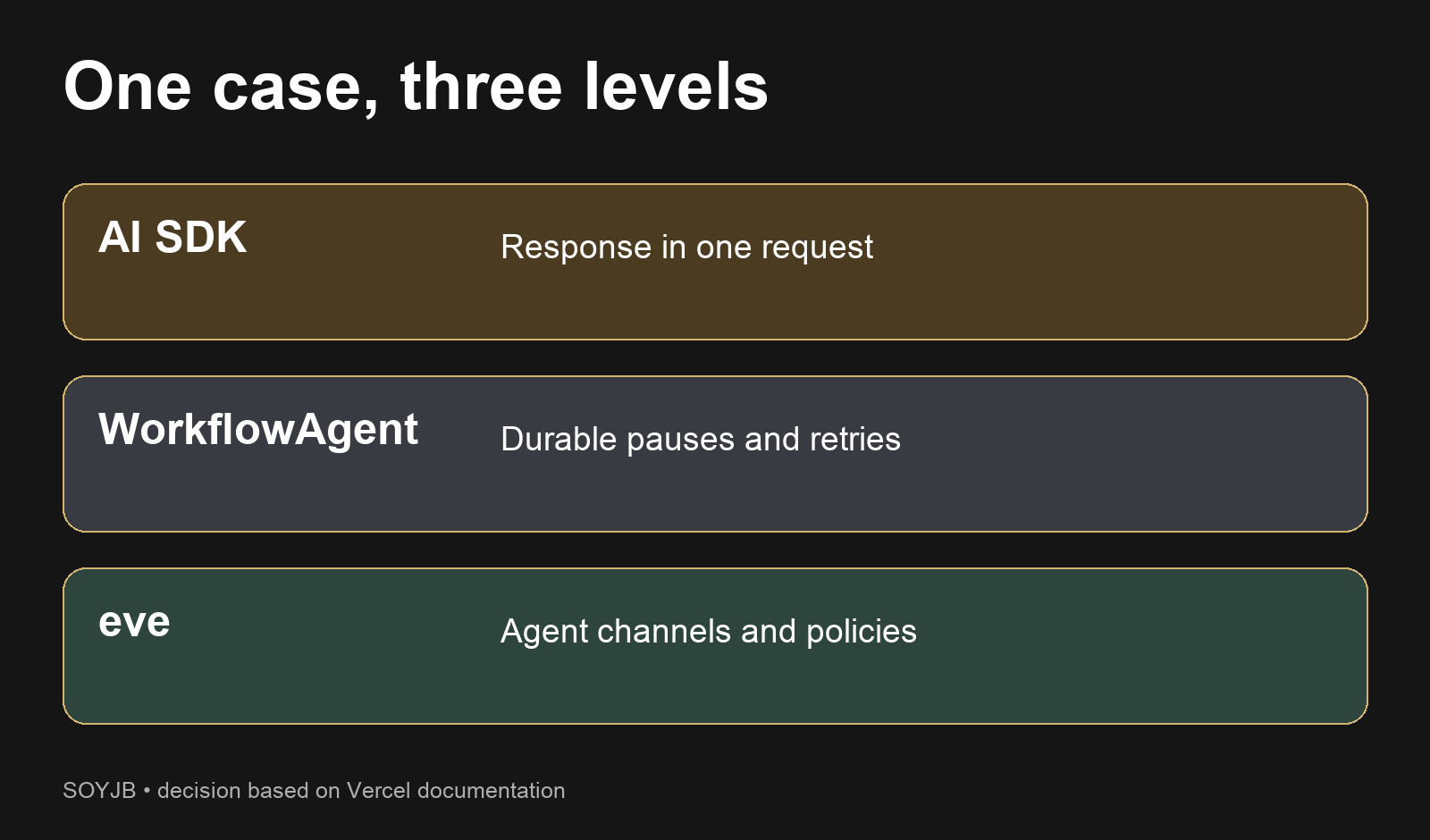
If a customer asks “where is my order?”, the assistant calls a tool, returns an answer, and finishes within one interaction, start with AI SDK. AI SDK 7 supports model calls, tools, approvals, observability, and multimodal work. You can define context, error handling, and output without first adopting durable sessions. A small prototype is easier to inspect when each request has a clear beginning, result, and failure path.
This does not mean AI SDK is only for chat or cannot take part in a larger system. It is a foundation used by higher layers too. The decision is about current scope. If you have not shown that the assistant must pause for hours or resume after a deployment, adding durability immediately may increase operational work without solving a user problem.
Level two: pause, retry, and resume
Now the assistant proposes a refund, but an operator must approve before any money moves. Approval might arrive hours later; the process may restart or be redeployed meanwhile. WorkflowAgent from @ai-sdk/workflow fits this requirement. Vercel presents it as durable agent execution that can retry tool calls, suspend for human approval, and resume after interruption. The AI SDK 7 announcement describes these capabilities.
The acceptance test is more useful than a feature list: start a development case, stop the process while it waits for approval, restart it, and check that the same run can finish without issuing a refund twice. Also simulate a timeout and a tool failure. “The framework can resume” does not mean your business action is idempotent. You still have to design that guarantee.
Level three: channels and agent operations
Suppose the same assistant receives requests from web and messaging channels, uses tools under approval policies, records what it did, and is evaluated against real cases. eve is a broader framework with durable execution, sandboxed compute, human approval, subagents, and evaluations. Vercel builds it on AI SDK, so these are not mutually exclusive internal technologies. The potential benefit is avoiding a bespoke agent operations layer once your product truly needs one.
There is a limit: if your product only classifies a form or drafts a short answer, adopting the entire eve framework does not make it better. Validate its deployment model, observability, and cost under your traffic. A framework may reduce integration work while making you depend on its project structure.
One case, three choices
- One request with tool calls and an immediate result: prototype with AI SDK; measure answer quality, cost, and error handling.
- Long waits or survival across restarts: evaluate WorkflowAgent; test continuity, retries, and idempotency.
- Multiple channels, policies, and ongoing audit: assess eve; verify permissions, traces, and a real workflow before migration.
I did not run all three against the same case or measure speed or cost differences. This decision tree is an inference from documented capabilities. Before selecting, write an acceptance test such as: “A request arrives, the agent proposes an action, a human approves, the system restarts, and the action happens once.” Use the simplest layer that passes the test your users actually require. If the task never waits, do not manufacture extra infrastructure.
Primary sources: Vercel framework comparison (August 3, 2026); AI SDK 7 (June 25, 2026); Introducing eve (June 17, 2026).