Your weekly product videos use the same synthetic narrator. It is recognizable, but the delivery that works for a 15-second hook feels rushed in a longer explanation. Changing the style prompt for every export can make the channel sound inconsistent. On November 4, 2026, Google added Voice remixing to Gemini 3.8 TTS: start with an existing voice, describe a relative change, and save a separate voice ID for future scripts. For a creator, the useful question is whether that variation stays consistent across different kinds of copy.
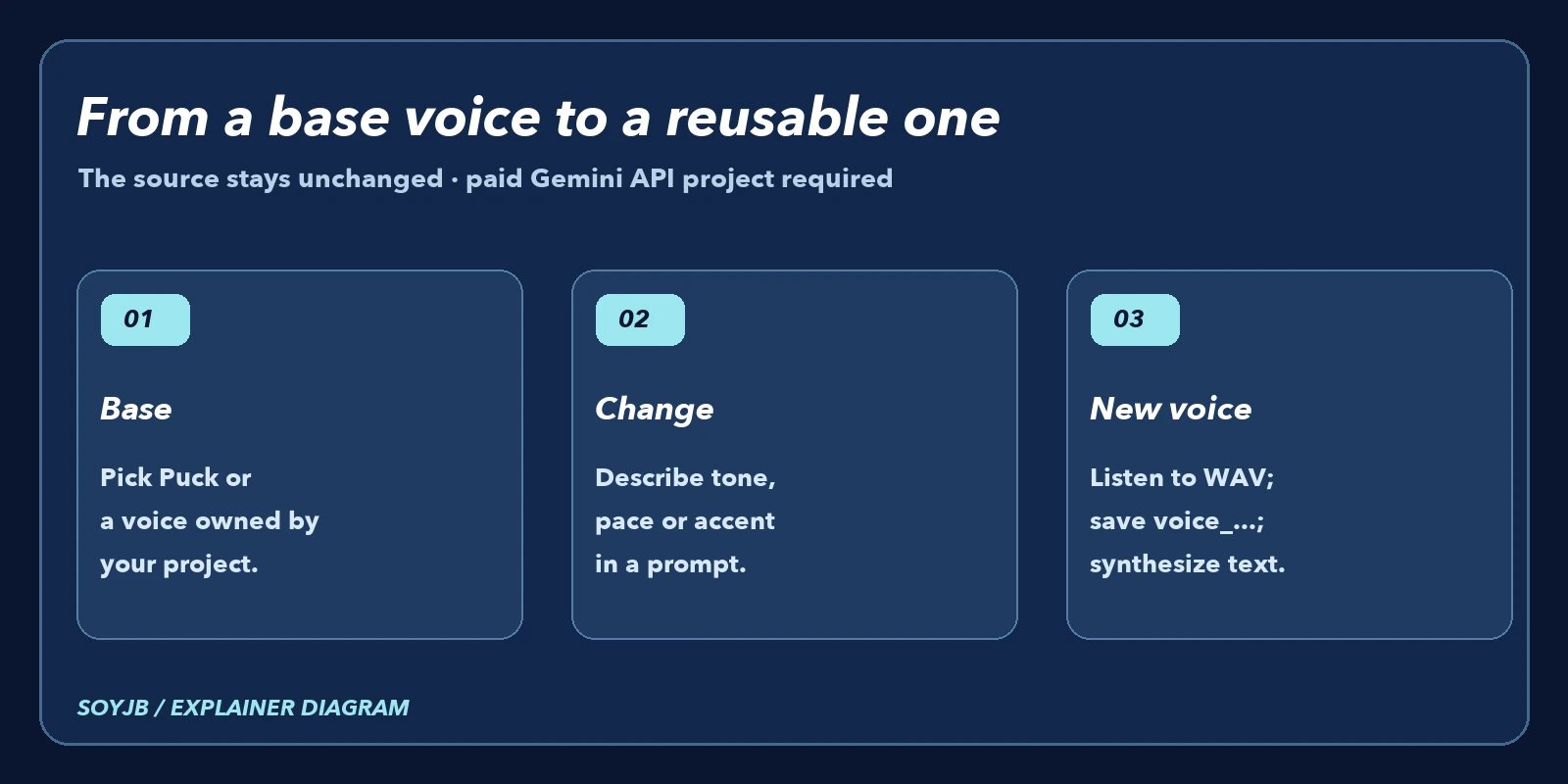
The Gemini API release notes date the feature to today. Google's Voice remixing guide says the base can be a prebuilt voice such as Puck, a voice from its extended library, or a custom voice owned by your project. You ask for a change in pitch, age, accent, energy or pacing. Google returns a new voice_... resource and a WAV preview; the source voice is not overwritten. The saved ID works with Gemini 3.8 Flash TTS and Flash-Lite TTS for synthesis, and the feature can be explored in Google AI Studio.
A useful test for a content team
Imagine a product-update series that needs a calmer narration while retaining the sound viewers already associate with it. Remix the current base voice once, then read the same three passages with the original and the new ID: a short opening, a minute-long explanation, and a sentence with names or numbers. Listen on a phone speaker as well as headphones. Compare pronunciation, pace and identity across all three, not just the attractive preview. Google documents the capability; SoyJB has not generated or assessed audio in a paid account. These are proposed evaluation steps, not measured results.
Try it in Studio or with the API
- Open Google AI Studio's speech workspace using a Gemini API project with billing enabled.
- Choose a prebuilt voice and request one measurable change, such as “keep the clarity, lower the pace slightly and use a steadier delivery for product explainers.” Avoid requests to imitate a real person.
- Listen to the generated WAV sample and save the returned
voice_...ID. - Render identical copy with the base and the remix. Keep the new one only if it improves the script without losing consistency.
For an app or repeatable workflow, the Python example below follows the structure in Google's reference. It needs google-genai 2.25.0 or later and a configured GEMINI_API_KEY. The syntax was checked against the documentation; the paid API call was not run by SoyJB:
import base64
from google import genai

client = genai.Client()
voice = client.voices.create(
    store=True,
    voice={
        "model": "gemini-3.8-flash-tts",
        "type": "prompted",
        "prompted": {
            "base_voice": "Puck",
            "input": "Keep the voice clear, but make it calmer and slightly slower for product explainers.",
        },
    },
)

print("Save this voice ID:", voice.id)
if voice.sample_audio and voice.sample_audio.data:
    with open("voice_preview.wav", "wb") as file:
        file.write(base64.b64decode(voice.sample_audio.data))

audio = client.interactions.create(
    model="gemini-3.8-flash-tts",
    input=[{
        "type": "user_input",
        "content": [{"type": "text", "text": "Today we are testing a new tool for creators."}],
    }],
    response_format={"type": "audio"},
    generation_config={"speech_config": [{"voice": voice.id}]},
)
with open("narration.wav", "wb") as file:
    file.write(base64.b64decode(audio.output_audio.data))
Access is the practical limit. Google's guide requires a Paid Tier 1 or higher Gemini API project for remixing. Designed, remixed and stored replicated voices share a 200-voice project limit. A stored voice expires one year after its last use; synthesis or a subsequent remix resets that window. Check the current TTS pricing and your project's usage before building a production voice library. The consulted guide does not clearly price an individual remix creation, so do not assume that this step is free.
Remixing is not cloning
Choose remixing when an existing voice is close and you need a controlled variation. If none fits, Voice design starts from a description instead. Replicating a person's voice from audio is another workflow with different consent concerns. For a public campaign, use voices you are entitled to use and get permission if a real speaker is involved. A synthetic sample can demonstrate the feature, but it should not be passed off as a recording of someone who never spoke those words.
The small decision this week is to make one variation and compare it against the base using the same script. If the new ID does not improve the narration, keep the original. A newly available feature is only valuable when it makes the finished piece better.