
An AI-built app can work in a demo and still leave an authorization path open. On November 5, 2026, OpenAI introduced GPT‑6 Cyber, a model for authorized security research that the company says can find and validate vulnerabilities more effectively while better respecting a researcher's defined scope. For a founder, the useful questions are who can access it, what evidence a finding should include, and how a finding becomes a verified fix.
What OpenAI reported
In its official announcement, OpenAI reports 48.5% on ExploitGym versus 32.1% for GPT‑5.6 Cyber. In a separate scope-following evaluation, it says the model avoided out-of-scope services in 99.93% of tests without the deployment prompt and 100% with that prompt. Those are OpenAI-reported evaluation results, not a promise that every real deployment will catch every issue or never exceed its scope. The company's Linux and Firefox examples describe particular investigations; they are not success rates you can transfer to your own app.
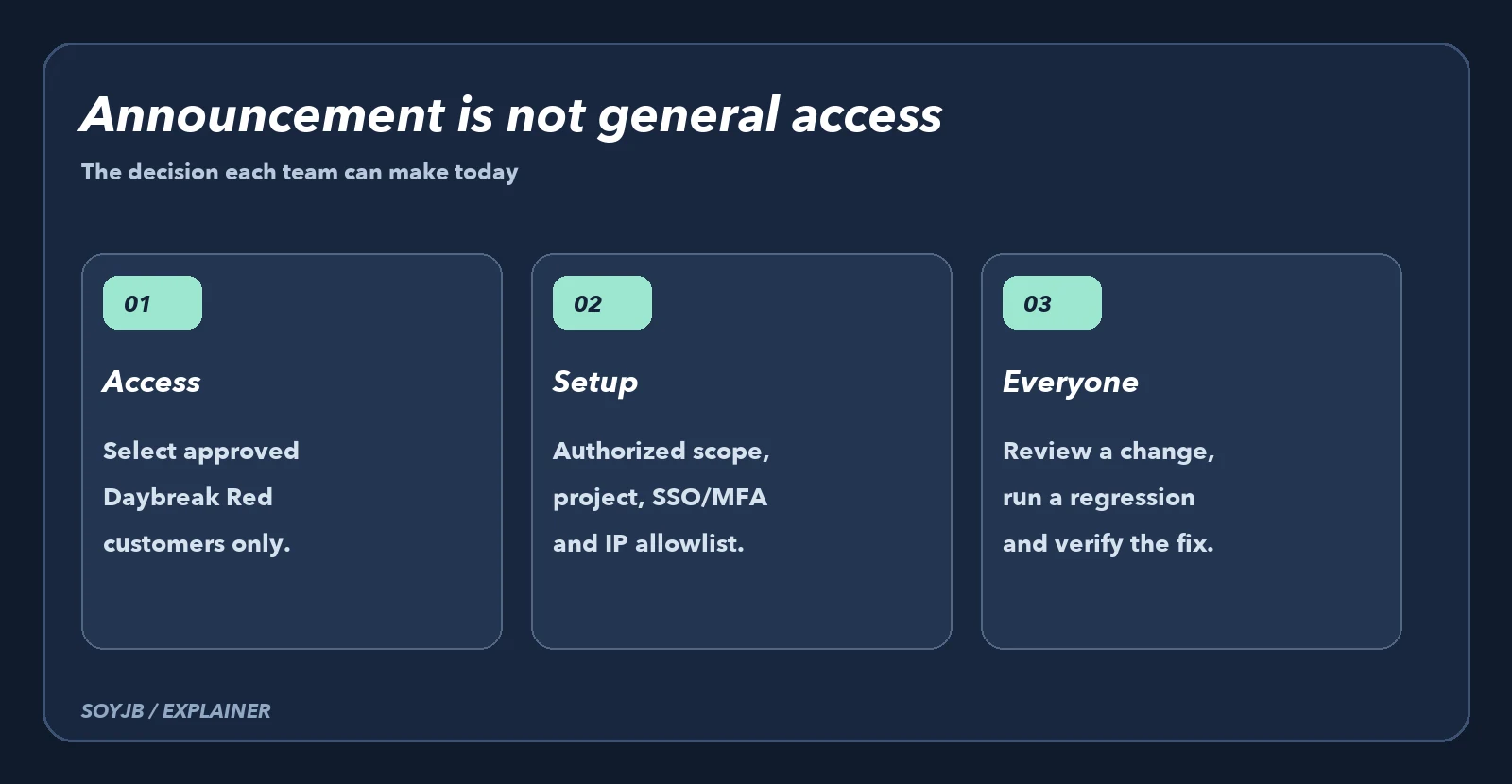
Initial access is narrow: the API and Codex for a selected group of approved Daybreak Red customers. OpenAI plans to expand to the rest of Red customers progressively. A normal ChatGPT subscription, Codex installation, or API key does not grant GPT‑6 Cyber access. The Daybreak guide also requires model-specific approval and project enablement; API use calls for organization SSO with MFA and IP allowlisting. A Zero Data Retention project needs Private Safety Processing. Putting the model name in a request is not a substitute for those controls.
What to do without Daybreak Red
For a product built with AI, start with a small, repeatable defensive workflow. Pick a recent change in your own repository, list the data it touches, and define which routes are in scope. Ask an available general-purpose model to review the diff without permission to run actions or contact external services. Then manually check each candidate issue, write a regression test, apply a patch, and run the suite. OpenAI says its mainline models already support code review, vulnerability triage, and patch development; that is an option available separately from restricted Cyber access.
Review this diff from my repository. Authorized scope: the attached files and authentication routes shown here. Do not run commands, contact external services, or assume production access. For each risk, give file and line, required condition, possible impact, evidence in the code, the smallest patch, and a regression test. If evidence is missing, label the claim “needs verification.”
The prompt structures a review; it is not itself a security test. Use code stripped of secrets and personal data, and check that the test fails before the patch and passes afterward. If a finding would require investigating a dependency or infrastructure outside the agreed scope, stop automation and obtain authorization. Track false positives: an agent that produces many alerts but few verified fixes can slow a team down.
The decision for a security team
If your organization already performs authorized penetration testing or maintains high-impact software, assess whether Daybreak Red and GPT‑6 Cyber fit your approval process, isolated test environment, and human review. Write down goals, permitted assets, exclusions, owners, and stop conditions before an experiment. Your own evaluation should count reproducible findings, time to patch, and scope errors, not just suggested vulnerability totals. We did not test the model, do not have Daybreak Red access, and did not independently reproduce the benchmark results.
Sources: OpenAI's November 5, 2026 announcement, the API changelog, and the Daybreak access guide. The announcement gives a date but no precise release time; this signal was discovered in the afternoon scan.