Your coding agent is about to read support tickets containing customer information. Model quality matters, but the first product decision is which provider receives that text and under what retention terms. On November 4, 2026, Vercel announced more Zero Data Retention (ZDR) providers for Kimi K3.1 Pro and Highspeed on AI Gateway. Vercel says Moonshot AI had previously been the only provider serving these models through Gateway. The change adds eligible routes; it does not make every agent “private” by default.
Why builders should care
The model IDs are moonshotai/kimi-k3.1-pro and moonshotai/kimi-k3.1-pro-highspeed. Vercel lists image input and a one-million-token context window for both, with Highspeed aimed at latency-sensitive work such as interactive coding agents. That is not a reason to paste an entire repository into every prompt. Large contexts cost money, can add noise, and do not replace file selection, permissions, or diff review.
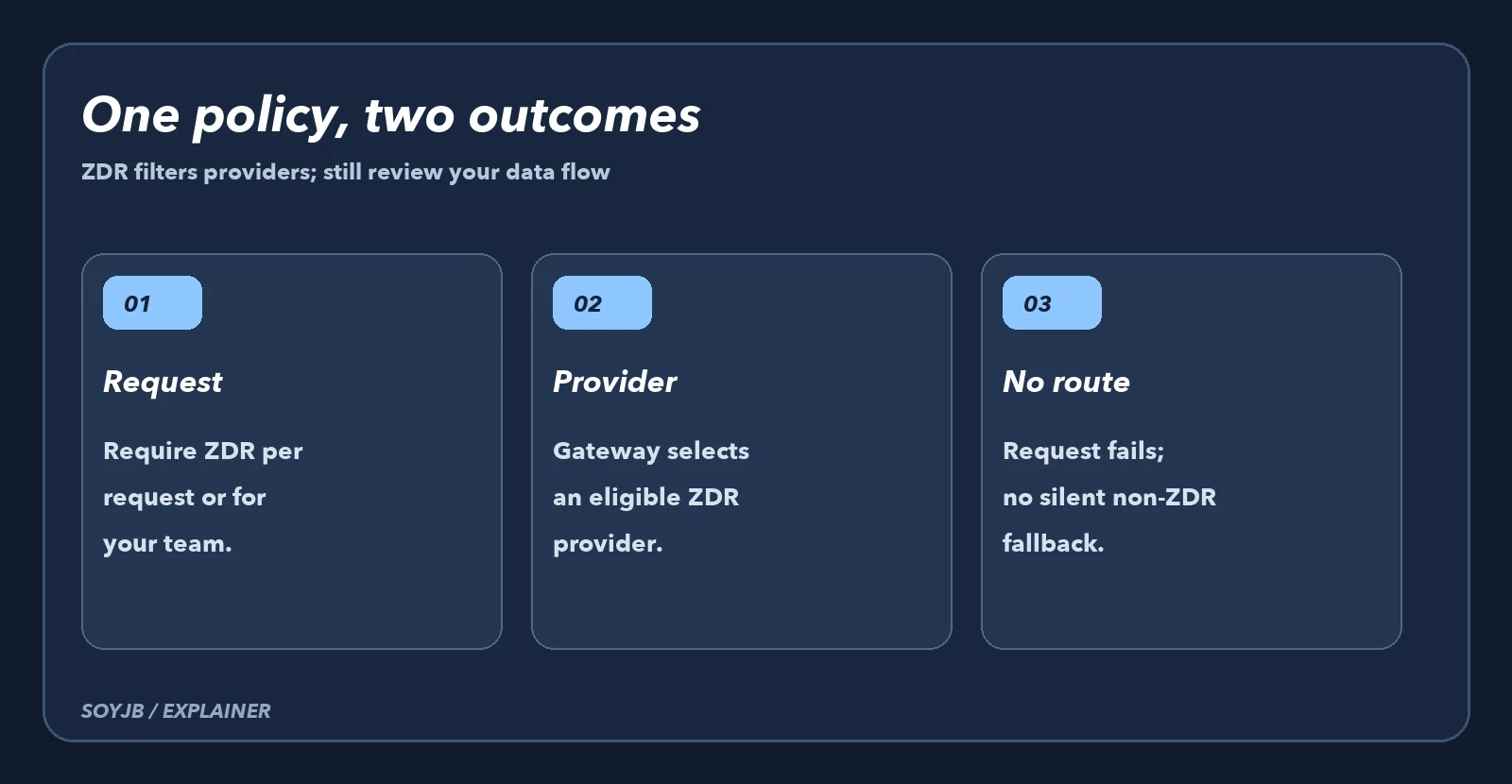
The useful change is in routing. When a request requires ZDR, Gateway selects only a provider with a ZDR agreement for that model. If none is available, the request fails instead of silently falling back to a non-ZDR route. Failing closed is a valuable product property when an error is preferable to sending client material to the wrong provider. You can request ZDR per call, or set a team-wide requirement in AI Gateway settings that also covers coding agents.
Try it with made-up data first
In an AI SDK 7 project with AI_GATEWAY_API_KEY configured, use a synthetic prompt. The important switch is providerOptions.gateway.zeroDataRetention. This copyable zdr.ts example follows Vercel's documented pattern; we did not run a billable request here.
import { generateText } from 'ai';

const { text } = await generateText({
  model: 'moonshotai/kimi-k3.1-pro',
  prompt: 'Using fictional data, summarize three booking-app support tickets.',
  providerOptions: {
    gateway: { zeroDataRetention: true },
  },
});

console.log(text);
Check that your team is eligible for ZDR, the call takes an eligible route, and your application handles a missing route. Vercel's documentation says ZDR requires a Pro or Enterprise team, or a team that purchased AI Gateway credits. An ineligible account receives a 403. If no ZDR provider is available for the chosen model, Gateway returns a “no providers available” error. Testing with invented tickets lets you validate configuration and spend before touching customer records.
What ZDR does not settle
ZDR addresses data retention for covered Gateway routes and participating providers. It is not blanket permission to upload secrets or an automatic compliance certificate for your app. Vercel notes that some provider models or functions may fall outside a provider's ZDR policy. Provider-executed tools, such as web search or grounding, may process and retain data under separate terms; Gateway does not necessarily fail those requests when ZDR is enabled. Review the tool's terms, redact keys, minimize sent content, and keep access control and audit practices in your own application.
If you bring your own provider key (BYOK), Vercel says Gateway skips it by default under ZDR. You can mark a key eligible when you hold the relevant agreement, but that flag alone does not turn on ZDR; the team or request setting still must require it. For a coding agent, first choose which files it may read, test against a toy repository, then compare Pro and Highspeed on the same task for latency and cost. More providers may improve the availability of a ZDR route, but the announcement is no proof that Kimi solves your own coding task better.
Sources and test status: Vercel's November 4, 2026 announcement and its ZDR documentation. We did not call the paid endpoint or measure latency, price, or output quality with a real account.