Your private repository has tests, but the app is not hosted on Vercel. Until November 3, 2026, enabling Vercel CI required a linked Vercel project. The new standalone flow removes that requirement for a private GitHub repository. For a small team building with coding agents, this changes a practical decision: you can add a push check before choosing where to deploy.
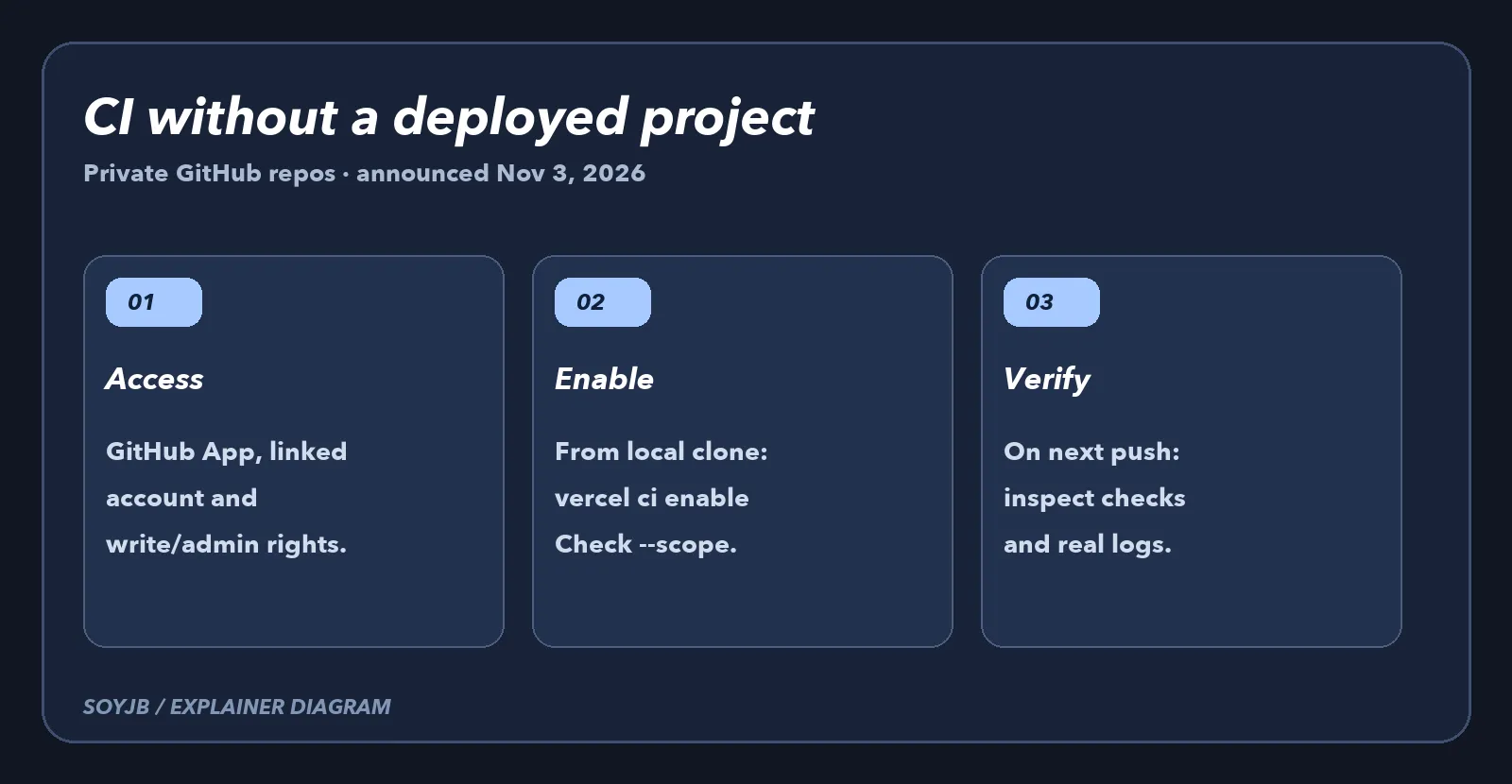
According to Vercel's announcement, the independent flow needs a private GitHub repository, a GitHub account connected to Vercel, access granted to the repository through the Vercel GitHub App, and write or admin permission. It does not announce this flow for public repositories or another Git provider. Those constraints matter more than the headline if your company keeps its code elsewhere.
Enable the check, then prove it runs
From the root of a cloned repository, run the command shown in the announcement:
vercel ci enableFor a specific team, the documented variant is vercel ci enable --scope <team>. The CLI walks through the repository connection and authorization. Before pushing, check the documented prerequisites: Turborepo 2.11.7 or later, Vercel CLI 64.3.1 or later, and tasks marked with "tags": ["ci"] in turbo.json. The configured, affected tasks run from the next push onward. Enabling the integration is not the same as verifying your tests: inspect the first GitHub check and its logs before making it a required branch rule. SoyJB has not run this setup in its own private repository; the workflow here is a proposed test, not a benchmark.
A minimal turbo.json entry for an existing test task is:
{
  "tasks": {
    "test": { "tags": ["ci"] }
  }
}
A focused test for an AI-built app
- Choose a private repository with Turborepo and one fast test that already passes locally. Write down its command and baseline runtime.
- Confirm that your GitHub account is connected, the Vercel GitHub App can access this repository, and you hold write or admin permission.
- Run
vercel ci enablefrom the clone and finish the CLI prompts. A Vercel deployment project is not required for this step. - Make a small push. Check whether the GitHub status appears, runs the intended task, and fails when the test fails. Record total time and whether the failure log tells you what to fix.
- Confirm that the task has the
citag inturbo.json. Only then consider making the check mandatory for merges. A check that never starts can create false confidence.
Imagine an agent edits a sign-in flow and pushes a branch. If an authentication test fails, the check gives the reviewer a reason to stop before merging. The useful outcome is an observable gate, not an AI label on your CI. If you already use GitHub Actions, run the same test in both systems and compare reliability, time, and spend. This announcement does not establish that one is faster or cheaper for your repository.
Where the announcement stops
The change removes the Vercel project prerequisite for private GitHub repositories. It does not create a deployment, design your tests, or remove GitHub permissions. Check the current Vercel CI documentation for task configuration, limits, and pricing before adopting it in production. The general documentation was last updated October 28 and still describes the older linked-project setup; the November 3 announcement is the source for the new standalone flow. If your repository is public or on another provider, do not assume the standalone path applies. That is the boundary to verify before scheduling a migration or adding a second CI tool.