A five-second ad sounds like a small experiment. With generated video, however, changing the model or adding an input video can change your bill before you have a single usable take. Kling 4.0 Flash arrived on Runway Dev on November 5, 2026 with a clear scope: 3–20 seconds of 720p video, audio included, generated from text, a first frame, image or video references, or an existing clip. The useful question for a creator is not how good a promotional sample looks. It is how to test your own concept and understand the cost.
What changed and who can use it
The API model ID is kling_4_flash. Runway lists it on text-to-video, image-to-video, and video-to-video endpoints. A creator making Shorts or paid social concepts can request vertical 720:1280 framing from text and get sound in the same generation. With an image, the first frame anchors composition; with a source video, the model can edit a shot. This is specifically Runway Dev access. It does not establish that every Kling subscription or interface exposes the same controls.
Flash tops out at 720p and 20 seconds. The standard Kling 4.0 model also offers 1080p and up to 30 seconds. Flash therefore makes sense for short concept tests. A final deliverable that needs higher resolution or length may need another model or further editing. Neither model guarantees readable text, stable characters, correct product details, or commercial readiness without human review.
Budget the experiment first
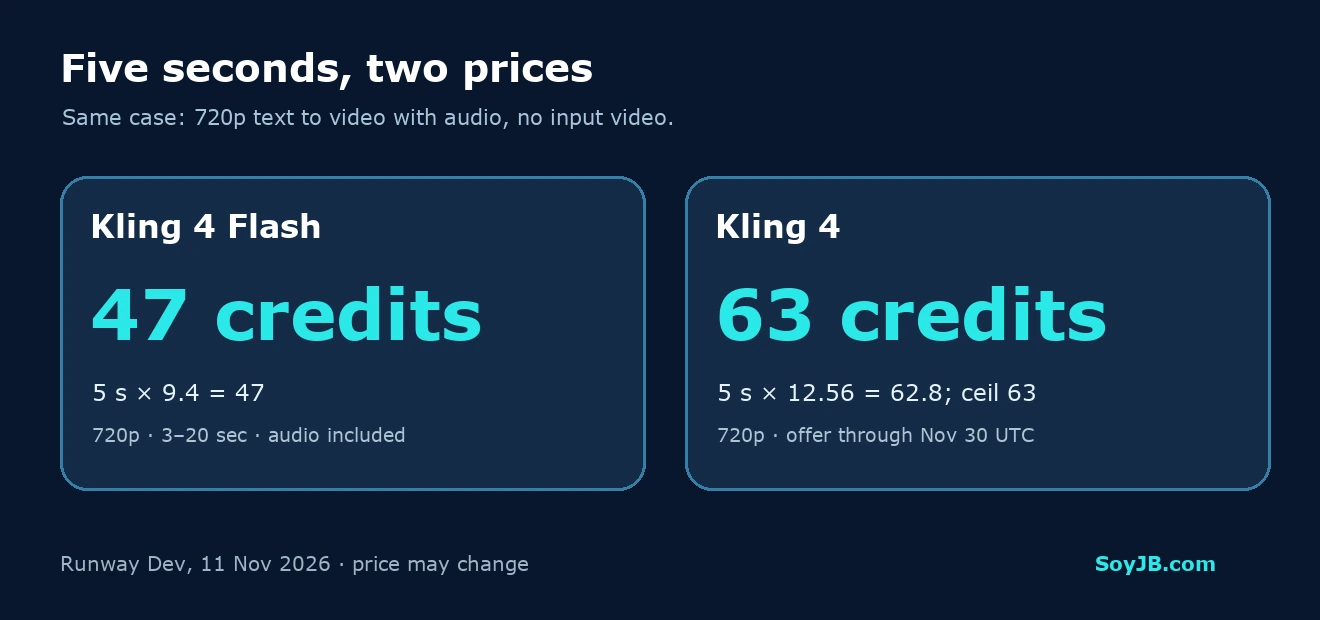
Runway lists 9.4 credits per output second for Flash when there is no input video, with the total rounded up to a whole credit. A five-second clip costs 47 credits; ten seconds cost 94. For the same 720p, five-second text-to-video case, standard Kling 4.0 is temporarily priced at 12.56 credits per second through November 30, 2026 UTC, a 20% discount. That is 62.8 credits, rounded to 63. This compares documented billing, not visual quality.
Editing a video uses a different formula. Flash charges 6.3 credits per output second plus 6.3 credits per second of the larger of total input-video duration and output duration, then rounds up. Runway's examples put a five-second output with three seconds of input at 63 credits, and one with ten seconds of input at 95. Video references are different from image references for billing: the duration of input clips matters. Runway says image references have no separate fee for this model. You may provide up to ten images including the first frame, and up to five videos totaling at most 20 seconds, including the source clip.
A fair test you can run today
- Choose one five-second ad concept. For example, show a physical object rotating on a table under side light. Specify one action, one camera move, framing, and sound. Asking for several scenes in five seconds makes the outcome hard to judge.
- Generate a vertical
720:1280version from text withkling_4_flash. Record the duration, charged credits, and whether the audio helps. If that model ID is unavailable, confirm you are using Runway Dev. - Only if useful, repeat the same prompt and duration with standard Kling 4.0 at 720p. Changing the scene or aspect ratio at the same time would muddy the comparison.
- Score object continuity, hands or text if present, camera movement, audio clarity, and whether the shot fits your edit. Reject a poor direction before paying for longer variations.
A copyable starting prompt for a product you own: Vertical 9:16, five seconds. A plain reusable water bottle on a neutral table. Single slow camera orbit, soft side light, realistic materials. One continuous shot, no cuts, no logos, no on-screen text. Gentle ambient sound only. This is a proposed experiment, not a claim that we ran a paid generation.
Limits that affect the choice
Runway documents a 3–20 second range at 720p, defaulting to five seconds. Image-to-video accepts a single first frame, not intermediate or final frames. Reference media cannot rescue an unclear brief. The prompt limit is 26,000 English characters or 11,000 non-English characters, shared for mixed-language prompts; the test above needs only two sentences. Input framing and size matter too: first-frame images and videos must have an aspect ratio from 0.4 to 2.5; images need at least 300 pixels on each side, videos at least 700 pixels on each side.
My decision rule: start with Flash when you need to validate a short vertical video with audio at the lower documented cost. Move to standard Kling 4.0 or another model when a controlled test shows you need 1080p, more than 20 seconds, or a capability Flash lacks. Compare cost per usable take, not merely cost per generated second. Your usable-take rate requires your own tests; we have not invented one.
Primary sources, checked November 11, 2026: Runway Dev changelog, November 5 announcement; pricing and billing examples; input parameters and limits. Availability and prices may change after this date.