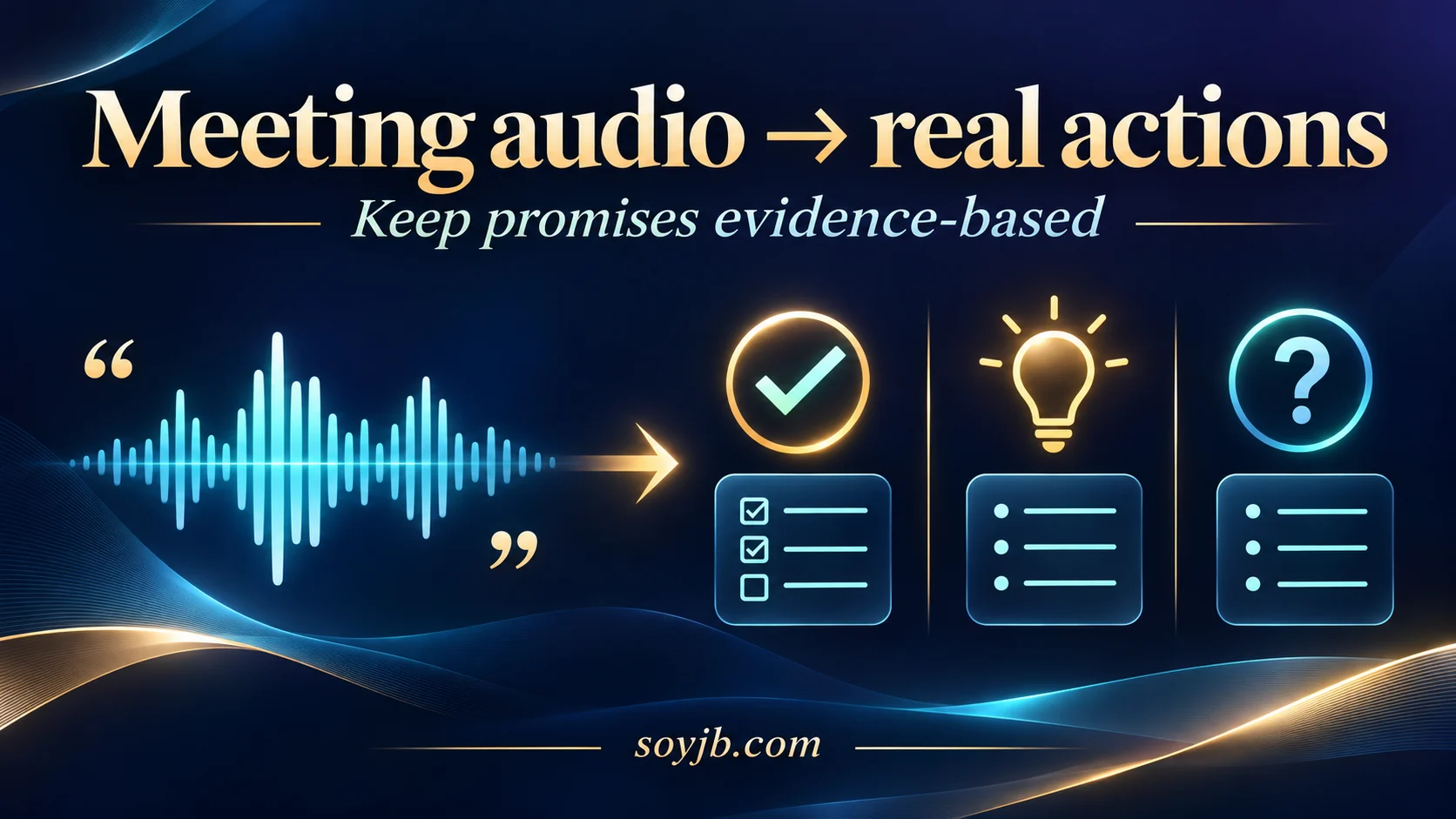
You leave a 25-minute meeting with a recording and a risky assumption: “I think Ana said she would send the proposal on Friday.” If an AI summary turns that guess into a confirmed task, it creates a commitment nobody made. A useful workflow separates decisions, tentative ideas, and work that still has no owner.
The process is simple: transcribe the call, correct names and numbers, ask for an evidence-backed action table, and check each commitment before sharing it. Use it for a customer call, a product meeting, or an interview. The goal is an accurate list of next steps, not a beautifully written but unreliable recap.
1. Get a transcript while preserving context
If you need a starting point, SoyJB's audio-to-text tool accepts MP3, WAV, OGG, M4A, FLAC, and WebM files up to one hour and 100 MB. Its product page says default processing runs in your browser; the optional server mode sends the file to an external provider. Choose deliberately when a call contains customer information. Download the transcript and keep the original recording so you can resolve disputed phrases.
Before summarizing with a model, check names, amounts, dates, negations, and product terminology. Speech recognition can turn “we are not shipping Tuesday” into “we are shipping Tuesday.” Replay the snippets that determine a delivery or payment. If the transcript has no reliable speaker labels, do not guess who owns an action.
2. Require a quote for every extracted item
Paste a corrected transcript into your chosen model and use this prompt. If the call is sensitive, remove personal data or use a service whose data handling you have reviewed. Local transcription does not make a later upload to another AI service local.
Act as a meeting secretary. Extract only facts supported by the transcript.

Return four sections:
1. DECISIONS: decision, short verbatim supporting quote, and timestamp if available.
2. CONFIRMED ACTIONS: action, explicitly named owner, explicit due date, and quote.
3. UNAPPROVED PROPOSALS: idea and proposer, without turning it into an action item.
4. OPEN QUESTIONS: unresolved decision, owner, or date to confirm.

Rules: do not invent names, deadlines, or numbers. If an owner or date is not
explicit, write "to confirm". Do not attribute a statement to a speaker unless
the transcript identifies that person. Preserve negation and uncertainty.
Every row needs a quote copied from the transcript; exclude items without evidence.

TRANSCRIPT:
[paste reviewed text here]
This is a reusable template, not a claim that any model will be perfectly accurate. A quote makes the output auditable; it does not prove the quote exists until you look it up in the original text.
3. Separate agreement from possibility
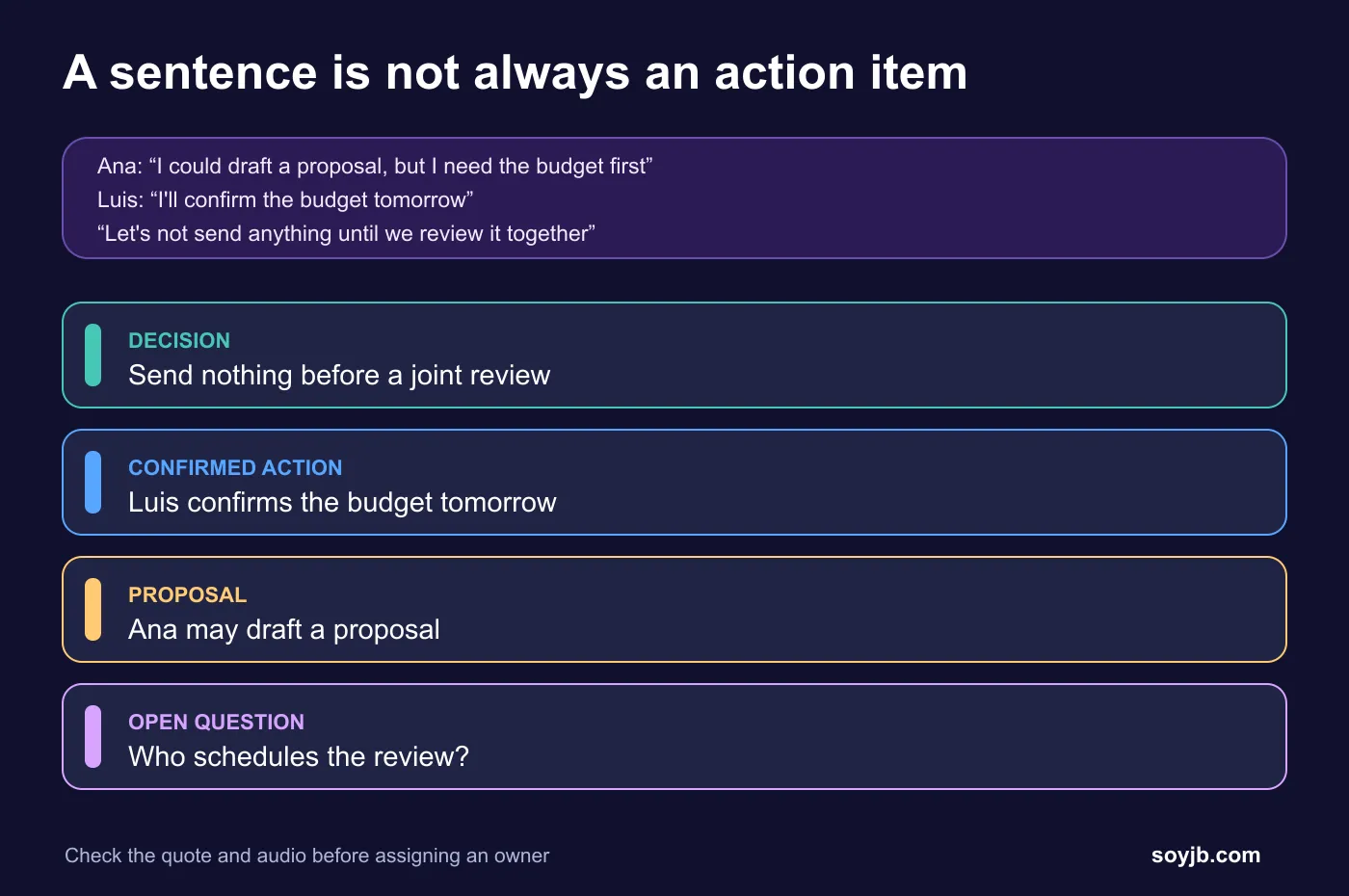
Consider this fictional exchange: “Ana: I could draft a proposal, but I need the budget first. Luis: I'll confirm the budget tomorrow. Let's not send anything to the customer until we review it together.” The correct takeaway is not “Ana will send the proposal tomorrow.” The evidence supports:
- Confirmed action: Luis will confirm the budget tomorrow. Quote: “I'll confirm the budget tomorrow.”
- Conditional proposal: Ana may draft a proposal after the budget arrives. Quote: “I could draft a proposal, but I need the budget first.”
- Decision: send nothing to the customer before a joint review. Quote: “Let's not send anything to the customer until we review it together.”
- Open question: who schedules the review, and by when? The excerpt does not say.
I wrote this example manually to show the distinction. It is not the output of a tested model or a real meeting. If a transcriber omitted speaker identities, replace “Ana” and “Luis” with “unidentified speaker” until you verify the audio.
“Tomorrow” is a relative date. Before setting a reminder, resolve it against the meeting date. If the recording date is unknown, leave the deadline unconfirmed.
4. Review for two minutes before sending
- Search the transcript for each supporting quote. If a phrase is not there, delete or correct the row.
- Replay statements involving dates, money, or negations. Compare the audio with the text.
- Ask participants to confirm any ambiguous owner or deadline. “To confirm” is better than a fabricated assignment.
- Send a concise recap with decisions, owned actions, and open questions. Link to the reviewed notes instead of pasting the entire transcript.
If you automate tasks in a project tracker, add a human approval step. Only confirmed actions should become assigned tasks. Keep proposals and open questions as notes until someone accepts them. That boundary prevents a plausible summary from becoming a false instruction.
Source and scope
SoyJB audio-to-text product page for supported formats, limits, and processing modes. The four-section framework and review procedure are SoyJB's editorial method; test them with your own meetings.