Picture an agent preparing twenty product cards. The main model plans the job, then keeps paying to handle every small step: extract three fields, summarize a card, or draft one line. On November 9, Vercel added Meta's Muse Ember to AI Gateway. A smaller model might handle those bounded steps for less. The question is whether the answers stay accurate enough to use.
What is available, and what it costs
The model ID is meta/muse-ember. Vercel positions it for coding subtasks, tool calls, and document analysis. It accepts text and images, supports tool use, and offers roughly a million tokens of context. On November 10, Vercel's model page listed $0.10 per million input tokens and $0.50 per million output tokens. Recheck pricing and credits before running a batch.
You can call it through AI SDK, Chat Completions, Responses, or Messages. Vercel also documents connecting coding agents with npx vercel ai-gateway setup. A large context window is a capability ceiling, not a reason to send an entire repository to every small task. Nor does availability prove this model can replace the planner in your particular agent.
Test one narrow job first
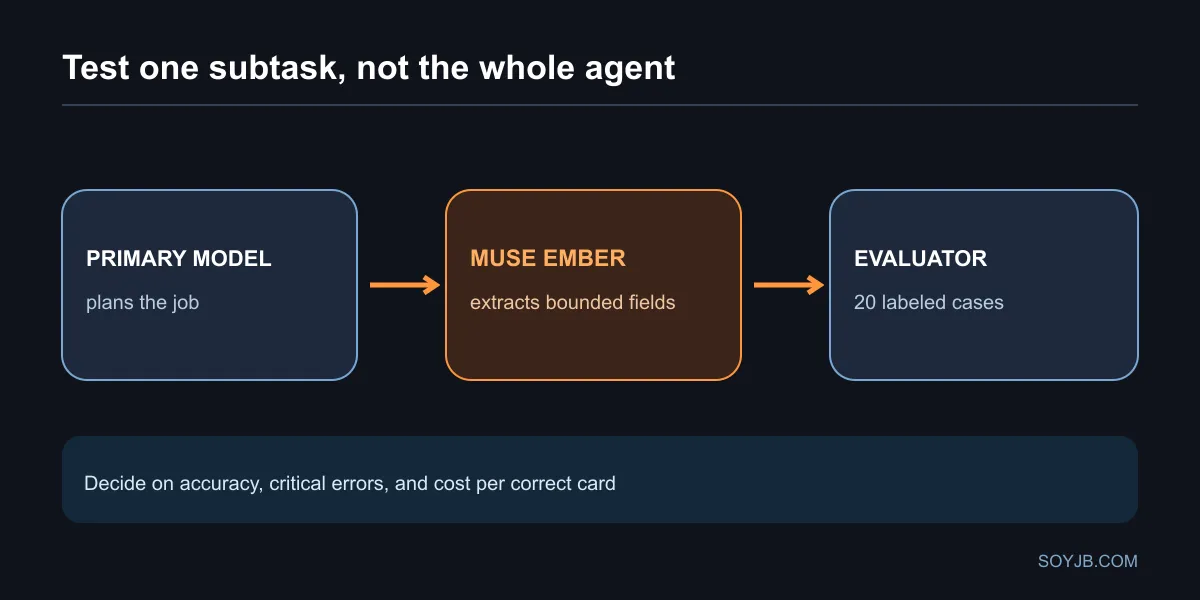
Choose a repetitive operation with a verifiable answer: extracting name, price, and currency from product listings. Prepare 20 sample listings, including five tricky ones: an old price crossed out, no currency, two variants, unclear tax treatment, and no price at all. Label the correct answers yourself before comparing Ember with your current model. Give both models the same inputs and output contract.
Paste this into AI Gateway's playground or your evaluator, replacing the listing. It requires no access to live customer accounts:
Extract only facts explicitly present in the listing. Return JSON
with name, price, currency, and evidence. Use null for missing data.
Do not infer taxes, discounts, or currencies.

LISTING:
"Studio Plan. Was: $49. Now: $29/month. USD."
For that illustrative listing, the expected answer is {"name":"Studio Plan","price":29,"currency":"USD","evidence":"Now: $29/month. USD."}. It should select the current price, not the former one. This JSON is a test target, not a result we observed from Muse Ember.
Decide with completed-task economics
Count correct answers out of 20, critical errors, and appropriate abstentions. Log input and output tokens, latency, and total cost per correctly completed card. Cost per million tokens alone misses rework. If Ember saves money but invents a currency for ambiguous listings, keep the original model or add a verification step. Repeat on a second job, such as a small code helper with tests, before changing an entire agent pipeline.
For arithmetic only, 1,000 calls with 2,000 input and 500 output tokens each would cost about $0.45 at the listed rates: 2 million input tokens at $0.10 plus 0.5 million output tokens at $0.50. This is hypothetical and excludes caching, tools, retries, and later price changes. Long prompts can erase the advantage of a low-cost model assigned to tiny tasks.
Guardrails before production
Start with synthetic data. If the task uses tools, separate reads from writes and require human approval before publishing, charging, or changing records. Check Meta's terms and your AI Gateway retention settings when handling sensitive information. Vercel describes zero-data-retention support at the Gateway level, but your chosen route and provider still need account-specific verification.
The decision: Muse Ember is worth a bounded trial when tasks repeat often, risk is limited, and you can score the outcome. Keep your primary model for planning and ambiguous cases until your own measurements show the cheaper route preserves quality.
Sources: Vercel's November 9 announcement and model details and pricing. A live Muse Ember test has not been run for this article.