You are building an assistant that summarizes customer messages. You create a new Gemini API project, send a test prompt, and move on. The question left for later is where those prompts and responses are stored during development. On October 26, 2026, Google changed the default for new paid-tier projects: Generate Content requests are stored as logs unless you change the setting. If you are shipping an app for other people, that is a configuration worth checking before real data enters the system.
Which projects are affected
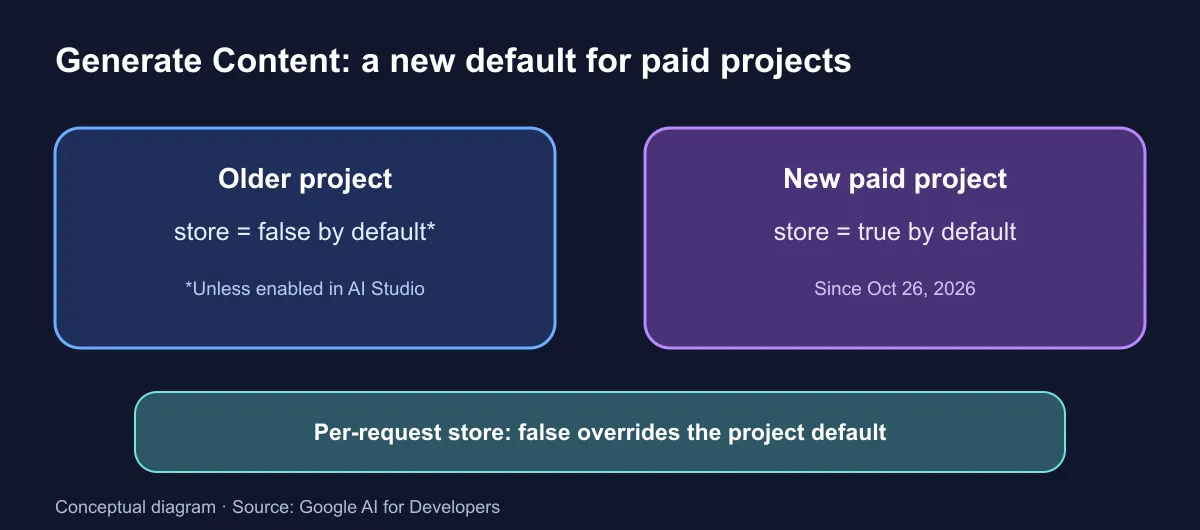
Google's Logs and datasets guide names generateContent, streamGenerateContent and batchGenerateContent. For projects created on or after October 26, their default is store=true. Earlier projects keep their Generate Content setting, which was off unless someone enabled logging. The Interactions API already stored requests by default to support server-side state management; do not mistake that older behavior for the new Generate Content change.
Gemini API logs are available for paid-tier projects. In AI Studio, authorized project users can inspect prompts, responses and context in log entries. Google states a 55-day default retention window, configurable to 7, 14, 28 or 55 days. Saving logs to a dataset changes their lifecycle. The store switch controls this documented request logging behavior; it is not a blanket claim about every aspect of Google's data handling.
A short audit before you launch
- Identify the actual project. Check whether the API key points to a new or older project and whether it is on the paid tier. Your SDK installation date does not tell you the project's default.
- Open AI Studio → Logs → Settings. Review the Generate Content and Interactions switches separately. Record who can view logs and the retention window.
- Inspect the inputs your app sends. If prompts might contain customer messages, private documents or secrets, use synthetic test data until your team decides what may be logged.
- Make the choice visible in code. A per-request setting is easier to review than an assumption about a project default. Add a test around the request configuration if this matters to your product.
Set storage explicitly on one request
Google says the request-level store property overrides the project default. This JavaScript example follows the official documentation. It needs @google/genai 2.31.0 or later and a configured Gemini API key. Use harmless sample text when trying it. I did not execute this against Joseph's Google account.
import { GoogleGenAI } from '@google/genai';

const client = new GoogleGenAI({});
const response = await client.models.generateContent({
  model: 'gemini-3.8-flash',
  contents: 'Summarize this synthetic test note.',
  config: { store: false },
});
console.log(response.text);
You can also disable the project-wide default in the Logs dashboard Settings. Treat the Interactions switch separately: Google warns that disabling its automatic storage can break server-side conversation-history retrieval unless individual requests override the setting. Check whether your application depends on previous interaction IDs or hosted state before changing it. If you need logs for debugging, decide what inputs are allowed and how long to keep them instead of accepting a default by accident.
A practical decision for this week
There is no reason to panic or migrate away from Gemini solely because of this release note. There is a reason to audit every new paid project before inviting users: creation date, API surface, store setting, log access and retention. Existing projects were not automatically switched to the new Generate Content default, but new ones now deserve an explicit product and engineering decision.