
You publish a website and want ChatGPT to find your articles, but you have not decided whether you want them used to train AI models. Those sound like one “allow AI” switch. They are separate choices. On October 30, 2026, OpenAI said it will honor a shared robots.txt signal for training preferences. “Will” matters: OpenAI aims to implement it in the coming months. Do not present it as a live control today.
What the announcement actually says
The proposed signal would let a publisher state one content-use preference to multiple participating AI providers, instead of maintaining a separate training rule for every crawler. The technical draft uses a robots.txt group named __usage_ai-training. It reuses existing User-agent, Allow and Disallow syntax. Yet it is an individual Internet-Draft, not an approved IETF standard, and OpenAI has not released its final implementation details. It does not automatically bind every AI provider.
The key distinction is that a training-use preference and a crawling rule address different questions. The draft treats them as independent. Blocking a search crawler may reduce discoverability even if your actual concern was model training.
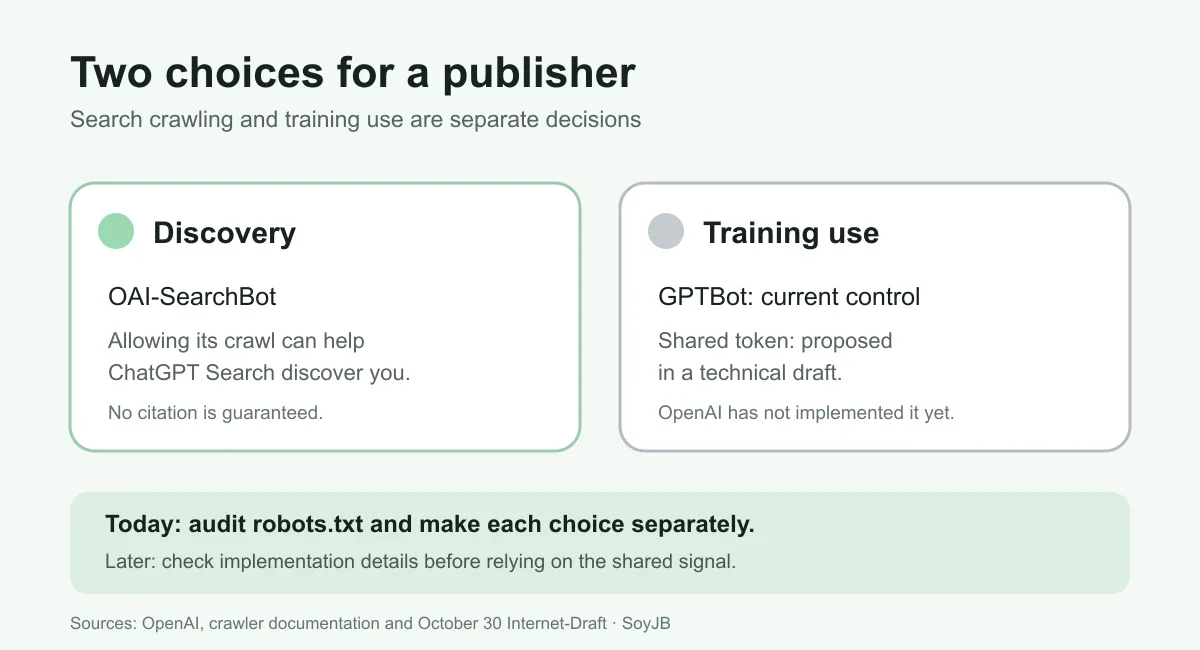
Controls that work today
OpenAI's crawler documentation separates OAI-SearchBot, which helps surface websites in ChatGPT Search, from GPTBot, whose crawled content may be used to train generative foundation models. A publisher can configure them independently. If your editorial choice is “allow ChatGPT search discovery, but signal no training through GPTBot,” a robots.txt example is:
User-agent: OAI-SearchBot
Allow: /

User-agent: GPTBot
Disallow: /
That is an example policy, not a universal recommendation. If your goal is wider distribution and you accept training, you may choose differently. Never replace your entire robots.txt with this snippet. You could accidentally remove rules for private paths, localized sections, other crawlers or your sitemap. Add narrowly scoped groups while preserving the existing file, then check the version your domain actually serves.
Audit your site in five minutes
- Open
https://your-domain.com/robots.txtin a private browser window. Confirm it serves plain text rather than a login page or error. - Find the
GPTBotandOAI-SearchBotgroups. Record your current policy and who can change it. On October 31, I checked SoyJB's public file: both agents are in a group withAllow: /. That is today's published configuration, not a permanent choice. - Write down two decisions: “Should ChatGPT Search discover this site?” and “What training-use preference do we want to express?” Other providers may still have separate controls while the common signal is not implemented.
- If you edit the file, keep a copy, change only the relevant groups, deploy and fetch the public robots.txt again. A line in the file does not prove traffic, citations or compliance.
OpenAI says its search systems may take roughly 24 hours to adjust after a robots.txt change. Allowing OAI-SearchBot does not guarantee a ChatGPT citation. ChatGPT-User covers certain visits initiated by users, and OpenAI notes that robots.txt rules may not apply to those requests.
What to watch next
For a publication like SoyJB, I would record the editorial preference now and wait for OpenAI's implementation update before treating the new policy token as effective. When that arrives, check the final syntax, participating providers, precedence against provider-specific rules and observed behavior. The draft signal concerns training use; it is not a switch that prevents every download, index entry, summary or citation.
The useful move for creators today is to avoid sacrificing search discovery because two different controls were conflated. Audit robots.txt and make the two decisions explicitly. OpenAI announcement · current crawler controls · technical draft.