
A client can now ask ChatGPT for a first draft. They may still need someone to turn that draft into a campaign, integration, or finished video. “I write prompts” competes with an action the client can try on their own. A testable deliverable includes scoping the problem, using tools, fixing errors, and being accountable for the result. A new OpenAI and Upwork study published November 10, 2026 helps explain this difference for freelancers, creators, and small studios.
What the research actually found
The researchers compared activities in sampled ChatGPT conversations with projects posted on Upwork Marketplace. Writing and advice carried more relative weight in ChatGPT use; technical implementation, visual production, and finished deliverables appeared more strongly in freelance requests. In 43 of 63 matched work categories, activities relatively common in ChatGPT lost share on Upwork while others gained. That is an association between distributions, not proof that ChatGPT caused those jobs to disappear. The datasets do not follow the same person from a prompt to a hire.
Project composition changed too. OpenAI reports that the mix of tasks in AI-related postings became 45% more diverse between early 2023 and late 2025, roughly like moving from 15 to 21 equally common tasks. Upwork says combinations of tasks that had been unusual were more than three times as common in AI-related projects as in other projects. One example is AI-generated video paired with editing and motion graphics. AI-related work also showed larger fixed-price budgets and more hours even after comparisons within the same work type and posting month; posted hourly rates were similar. A bigger budget may reflect broader scope, not a bonus for putting “AI” in your bio.
Combine capabilities around a client outcome
For a creator, a concrete offer could be “from idea to three vertical ads ready for testing.” Scope includes script, media rights, edit, captions, brand review, and final files—not merely generated images. For a builder, it could be “from form to working workflow”: interface, database connection, access controls, tests with separate accounts, and a handoff document. These are our example service packages, not segments or price points measured by OpenAI and Upwork.
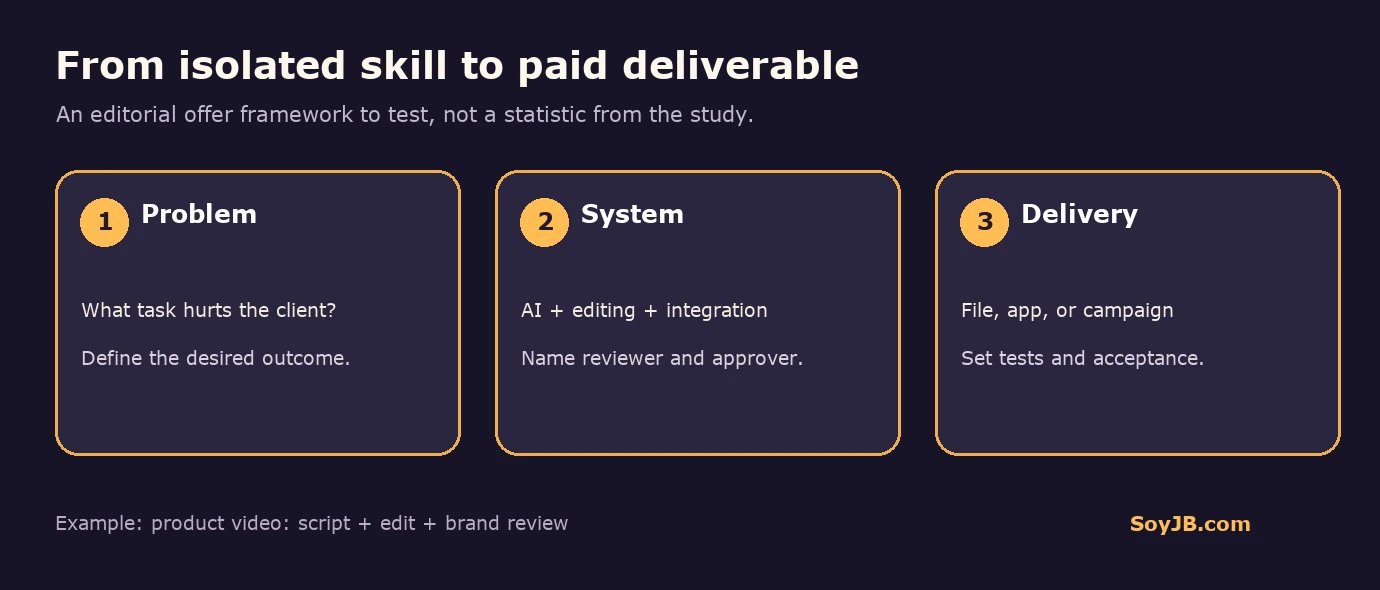
The language of the offer matters. Instead of “expert in twelve AI tools,” say what the buyer gets and how they will accept it. For example: “I deliver a landing page that captures leads, sends a test email, and exports records; we review five scenarios and I fix failures in that list.” AI may speed up parts of the work. The buyer pays for the outcome and quality control. Do not promise conversion rates or sales volume you have not measured.
Test an offer in seven days
- Pick a problem with evidence. Read ten real requests in your niche, customer interviews, or support messages. Write down the requested deliverable, not just the tools mentioned. If you use Upwork, remember its marketplace is not the entire labor market.
- Define a small package. Write one sentence covering client, result, timeframe, required inputs, three deliverables, and acceptance criterion. Exclude variants that would turn a fixed scope into endless revisions.
- Show the process. Build your own sample with fictitious data: input, AI draft, human changes, and final output. Get permission before displaying client work. Showing review and correction is more persuasive than a prompt gallery.
- Price all the work. Estimate research, generation, review, edits, coordination, and paid tools. For fixed fees, state the number of revisions. The research does not provide a universal rate card.
- Pitch five prospective clients. Ask which part they would pay for, which risk worries them, and what proof they need. Record answers and adjust scope before building a sales page.
Copyable offer template: I help [specific customer] achieve [verifiable outcome] within [timeframe], using [inputs]. I deliver [A], [B], and [C]. Acceptance means [observable test]. Includes [N] revision(s); excludes [clear boundary]. If any step needs private data, API permissions, or rights to images and voices, agree on those requirements in writing before work begins.
What the study cannot tell you
It does not show that every freelancer earns more by using AI, or that one person should perform every specialist role. Upwork posting data mostly run through 2025 and describe one marketplace; ChatGPT activity was measured over other windows. These figures are not a forecast for Latin America or any single niche. They do suggest a useful hypothesis to test: clients may pay more for combining capabilities and finishing work than for an isolated first draft. Your validation comes from customer conversations and real deliveries, not the report headline.
Primary sources: OpenAI, Work at the Frontier: AI’s effect on freelance work and Upwork, AI Is Changing How Work Comes Together, published November 10, 2026. The full report contains methods and tables.