Your Vercel Agent investigates a production error, reads logs and proposes a fix. The task finishes, but you do not know whether each session costs the same as it did last week. On October 27, 2026, Vercel said dashboard and Slack Agent sessions now cost 67% less on average. The useful response is not to triple your automation budget. It is to measure your own work before turning on recurring reviews or investigations.
What became cheaper, and what did not
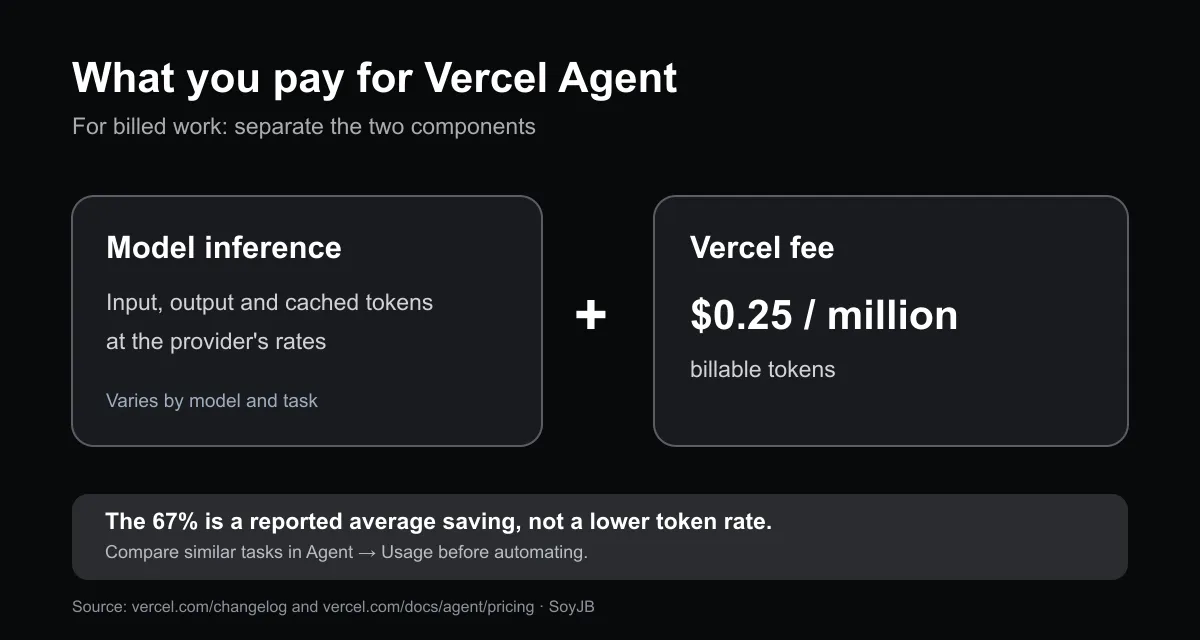
Vercel credits incremental context management, better prompt-cache reuse and guidance that helps Agent plan with fewer tokens. These changes are already live and require no migration. The 67% figure is Vercel's average, not a guaranteed per-session discount or a model price cut. A short question, a long Slack thread and an investigation that reads logs can have very different token profiles.
According to Vercel's pricing documentation, paid Agent work includes underlying provider inference with no Vercel markup, plus a $0.25 Vercel fee per million tokens. The fee applies to input, output and cached tokens. Provider rates differ by model and token type, so a single flat-rate multiplication will not accurately predict the full bill.
A 15-minute check on your own project
- Open Vercel Dashboard → Agent → Usage. Select a period before October 27 and note total cost, session count and the kind of work performed.
- Select a later period with comparable work. Do not mix quick questions with long production investigations or extensive code changes.
- For each task category, divide its total cost by its session count. If Usage exposes model and token details, inspect those too; the final bill is the business signal.
- Try one bounded task, such as “explain why this route returns 500 and propose a plan; do not apply changes.” Check its cost afterward. Repeat only for a real use case.
That is a measurement method, not a SoyJB benchmark. I have not accessed Joseph's Vercel account or measured his sessions. A smaller invoice also cannot be attributed to Agent's update without considering the model, conversation length and task complexity.
Check the triggers before automating
During the beta, Vercel's documentation lists 50 Chat messages per team member per day on each team; Slack shares that allowance. Approving an Agent plan can incur a charge even when free messages remain. Code Review has no included free usage. Observability Plus includes ten investigations per billing cycle, with extra investigations billed separately. For a team opening many pull requests, automatic reviews may matter more to the bill than occasional dashboard chat.
You can manage usage sources individually in Vercel settings: dashboard Chat, automatic Code Reviews and automatic alert investigations. Manual reviews and investigations may still incur charges. Before enabling any persistent workflow, define who needs it, how often it fires and when someone will inspect Usage again.
Should a builder change tools?
If you already use Vercel Agent occasionally to debug a deployment, the change is automatic; watch your actual cost. If you want Agent to review every PR, start with a small sample and compare both cost per task and answer quality before expanding. Set a team spending limit suited to your budget. If you do not use Vercel Agent, the 67% figure alone cannot show that it is cheaper than Claude Code, Cursor or another workflow. A fair comparison needs the same task, quality criteria and complete costs.
My take: lower average session cost makes long, project-aware tasks more appealing to test. It does not replace a decision based on your own data. Vercel announcement · official pricing and limits.