You finish a 20-minute interview with someone who built an app. There may be a short video, an article, and a carousel in it, but you cannot remember the exact wording of a key quote. Publishing three polished versions of the same vague takeaway would add little. A transcript gives you a working document; checking it against the recording keeps an AI assistant from inventing a perfect sentence no one actually said.
This workflow is for creators, educators, and founders who want to reuse an original conversation responsibly. The goal is not to multiply output for its own sake. It is to give each format a different job while preserving a path back to the source audio.
1. Transcribe while keeping the recording
Open SoyJB Audio to Text. Its tool page describes browser-based transcription by default, with an optional server mode. The Spanish product page lists MP3, WAV, OGG, M4A, FLAC, and WebM, with a 100 MB and one-hour limit; it offers plain text and time-coded .srt output. Check the current interface before relying on a particular limit, and check the mode before processing sensitive audio. The optional server mode sends the file to an external provider.
For interviews, keep the original recording and download the time-coded version if available. Record the speaker, date, topic, and context. Automatic transcription is a draft: names, numbers, acronyms, and negations are easy to mishear. If you plan to distribute another person's voice or words, confirm that you have permission for that use.
2. Separate claims from usable ideas
Read the transcript once before asking an AI model for finished copy. Mark factual claims that need independent evidence, opinions that must be attributed, and explanations you can turn into a useful tutorial. “I think” is not a proven result. A claimed growth figure needs a source or should be left out. If a sentence sounds suspiciously elegant, listen to the exact moment in the recording.
AI is helpful for structure, not source authentication. Remove private information before pasting a transcript into a third-party model. Then use a prompt that makes uncertainty visible:
Act as an editor for a technology creator. Use ONLY the transcript below.
1. Extract up to five useful ideas. For each, show the exact quote and timestamp if present.
2. Label any number, date, name, or claim needing external evidence as [UNVERIFIED].
3. Propose a 60-second video script, a practical article outline, and five carousel slides.
4. Give each format a distinct audience job. Do not invent quotes, outcomes, personal experience, or links.
5. Finish with "questions to confirm with the speaker" and "primary sources to find".
TRANSCRIPT:
[paste text or SRT here]
This prompt does not verify the transcript. It creates a visible checklist of questions. Listen back to every proposed quote and consult primary documentation for technical claims the speaker makes.
3. Give the three assets different jobs
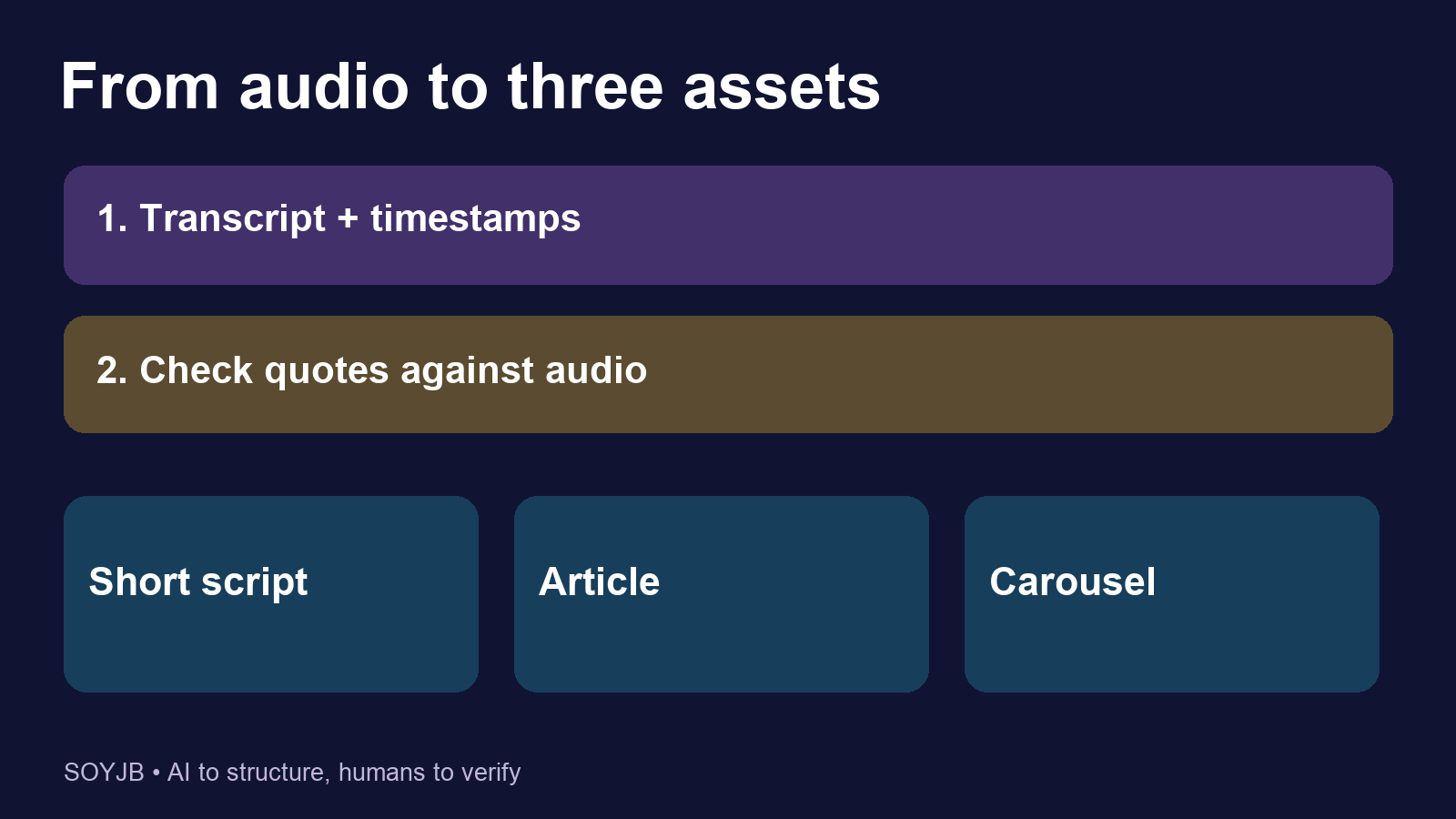
A short video should answer one question with a concrete example and, if useful, one verified quote. An article can go deeper: explain the problem, reproducible steps, tradeoffs, and limits. A carousel can show a sequence of decisions visually, one idea per slide, with a link back to the original conversation when it is public. Repeating the same paragraph in three layouts gives the audience no reason to engage with the second or third.
For example, an interview about launching a web app might yield a video on “the mistake of requesting data access too early,” an article with a permission-testing checklist, and a carousel contrasting the risky flow with a safer one. Same recording; different decisions for the audience.
4. Make the publication check explicit
Replay the seconds behind every quote. Check names and figures against the speaker or original records. Distinguish what the guest said from your own analysis. Credit or link the conversation if it has a public home. For a private conversation, agree on which excerpts can appear publicly. Your cover should communicate the real topic rather than a result the interview never established.
I did not run a sample interview for this article or measure time saved. This is an editorial workflow grounded in the functions described on SoyJB's tool page and the human verification needed before publication. The measurable quality bar is traceability: each quote maps to a timestamp, and each external factual claim has a source.
Source: SoyJB Audio to Text, product features and limits checked November 2, 2026.